Back to Blog
Clinic Operations7 min read·April 20, 2026

Why Your Dental Clinic Needs to Ditch Paper Registers in 2026

Paper registers made sense in 1996. In 2026, they're costing your clinic time, money, and patient trust. Here's the case for going fully digital.

The Paper Register Problem Nobody Talks About

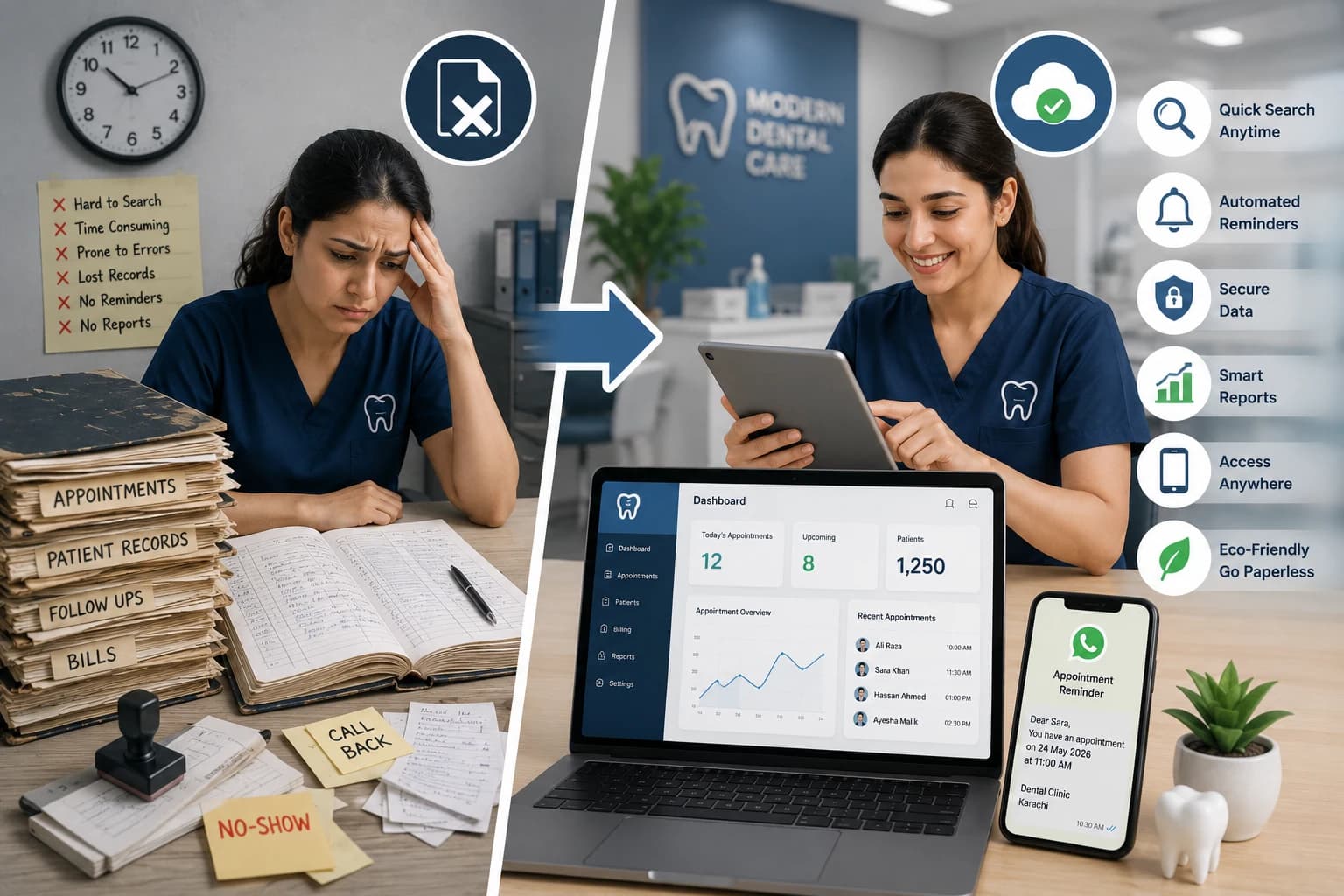
Walk into almost any dental clinic in Pakistan today and you'll still see it: the worn notebook on the receptionist's desk, overflowing with patient names, appointment times, and phone numbers written in three different colours of pen. Pages curled from humidity, entries scratched out and rewritten, handwriting that only one person in the entire clinic can actually read.

This is the state of patient data management in the majority of Pakistani dental practices in 2026.

And it's quietly costing clinics far more than they realise.


The Real Costs of Paper-Based Systems

1. Time: Your Most Valuable Resource

Think about how much time your receptionist spends on purely paper-related tasks:

  • Searching through registers to find a patient's last visit details
  • Re-writing appointment information when a patient reschedules
  • Flipping through pages to check which time slots are available
  • Copying patient information from one register to another for billing

In a busy clinic seeing 15–20 patients a day, these tasks can easily consume 2–3 hours of productive time daily. That's 60–90 hours a month — time that could be spent on patient care, marketing, or simply leaving on time.

2. Errors and Lost Data

Paper is inherently error-prone. Phone numbers get transposed. Names are misspelled. Appointment times get recorded in the wrong column. And when a patient calls to complain that they weren't reminded, or that their prescription was wrong, there's no audit trail to consult.

In a paper-based system, data errors are invisible until they cause a problem — and by then it's often too late.

3. The Single-Point-of-Failure Problem

Paper registers have a fatal flaw: they depend entirely on physical access. What happens if:

  • Your receptionist is sick and nobody else can read their handwriting?
  • The register gets water-damaged during a power outage?
  • You're at home and a patient calls to ask when their next appointment is?
  • A fire or flood damages years of patient records?

Digital records, stored securely in the cloud, are immune to every single one of these scenarios.

4. Zero Analytical Insight

Paper tells you nothing about your business. With a register, you cannot answer questions like:

  • Which day of the week generates the most revenue?
  • Which dentist has the highest patient retention rate?
  • What percentage of your patients are return visitors?
  • How many appointments were cancelled last month vs the month before?

These aren't luxury questions — they're the basic data points every clinic owner needs to make smart decisions about staffing, marketing, and pricing.


What Digital Actually Looks Like in Practice

Going digital doesn't mean buying complicated software that requires an IT degree to operate. Modern clinic management platforms like Denzif are built to be as simple as possible, with Pakistani clinic workflows in mind.

Here's what your daily operations look like after switching:

Patient Records in Seconds

When a returning patient walks in, your receptionist types their name or phone number and their complete profile appears instantly: personal details, medical history, allergies, past treatments, X-rays, prescriptions, and billing history — all in one place.

No digging through registers. No "one moment please while I find your file."

Smart Appointment Scheduling

The digital calendar shows you exactly which dentist is available, which chairs are occupied, and what time slots are open — without any mental arithmetic or page-flipping. The system prevents double-booking automatically and flags scheduling conflicts before they happen.

When a patient reschedules, one click updates everything. No crossing out. No rewriting.

Instant Treatment Documentation

After a procedure, the dentist can document the treatment digitally — including the tooth number, procedure performed, materials used, and clinical notes — using an interactive digital odontogram. This documentation is immediately linked to the patient's record and their invoice.

The next time that patient visits, you know exactly what was done and when.

Automated Billing

Because treatments are documented digitally, invoices generate themselves. Line items, quantities, unit prices, discounts, and totals are calculated automatically. You can share the invoice via WhatsApp in seconds — no printing, no handwriting, no manual math.


Addressing the Common Objections

"Our receptionist isn't tech-savvy."

Denzif was designed for this. Most clinics are fully operational within one training session. The interface is in clean, simple English with an intuitive layout — if your receptionist can use WhatsApp (and they definitely can), they can use Denzif.

"What if the internet goes down?"

Valid concern in Pakistan. However, modern clinic management software runs in the cloud and your data is always safely stored regardless of connectivity. For the brief periods your internet is down, you can note things temporarily and sync when you're back online.

"We've been using paper for 20 years. It works."

It works the same way a rickshaw "works" for transporting goods. It gets the job done — but it's inefficient, unreliable, and limiting. The question isn't whether paper works in isolation; it's whether it's the best tool available for the job. In 2026, it clearly isn't.

"It's expensive."

Denzif starts at PKR 7,999/month — less than the cost of one missed appointment per week. For what it saves in staff hours, errors, no-shows, and lost billing, the return on investment is immediate.


The Transition: Easier Than You Think

Switching from paper to digital feels daunting because it seems like an all-or-nothing leap. It isn't.

A practical approach for Pakistani clinics:

1. Start with new patients — register all new patients digitally from day one

2. Migrate active patients — during quieter hours, transfer your top 50–100 active patient records

3. Keep the register as backup for the first 30 days, just for peace of mind

4. Let go completely once your team is comfortable — typically within 4–6 weeks

Most clinics that make the switch describe the same experience: within two weeks, they can't imagine going back.


The Competitive Reality of 2026

Here's the uncomfortable truth: your patients are noticing.

Younger patients especially — the 25–45 age group that makes up a growing share of dental visitors — expect digital-first experiences. They expect appointment confirmations via WhatsApp. They expect their records to be accessible. They expect a professional invoice, not a handwritten receipt.

When they visit a clinic that runs on paper, it signals something about the overall quality of care — fairly or not.

In cities like Lahore, Karachi, and Islamabad, dental competition is fierce. The clinics that are growing in 2026 are the ones that present themselves professionally at every patient touchpoint. The registration process. The reminders. The invoices. The follow-up messages.

All of that starts with ditching the paper register.


Conclusion

Paper registers are a legacy tool in a digital world. The transition to a modern clinic management system isn't just about convenience — it's about data security, patient experience, business insight, and staying competitive.

Denzif offers a 7-day free trial with full access to every feature. You don't need a credit card. You don't need an IT team. You just need 15 minutes to set up your clinic profile and you're ready to go.

Your patients deserve better records. Your team deserves better tools. Your business deserves better data.

Ready to put this into practice?

Start your free 7-day Denzif trial. No credit card. Full access. Setup in 15 minutes.