How to Handle Dental Patient Complaints Professionally (2026 Playbook)
Prompt complaint resolution keeps up to 95% of patients loyal. Use this 5-step LEARN playbook to handle billing disputes, wait times, and negative reviews.
Quick answer
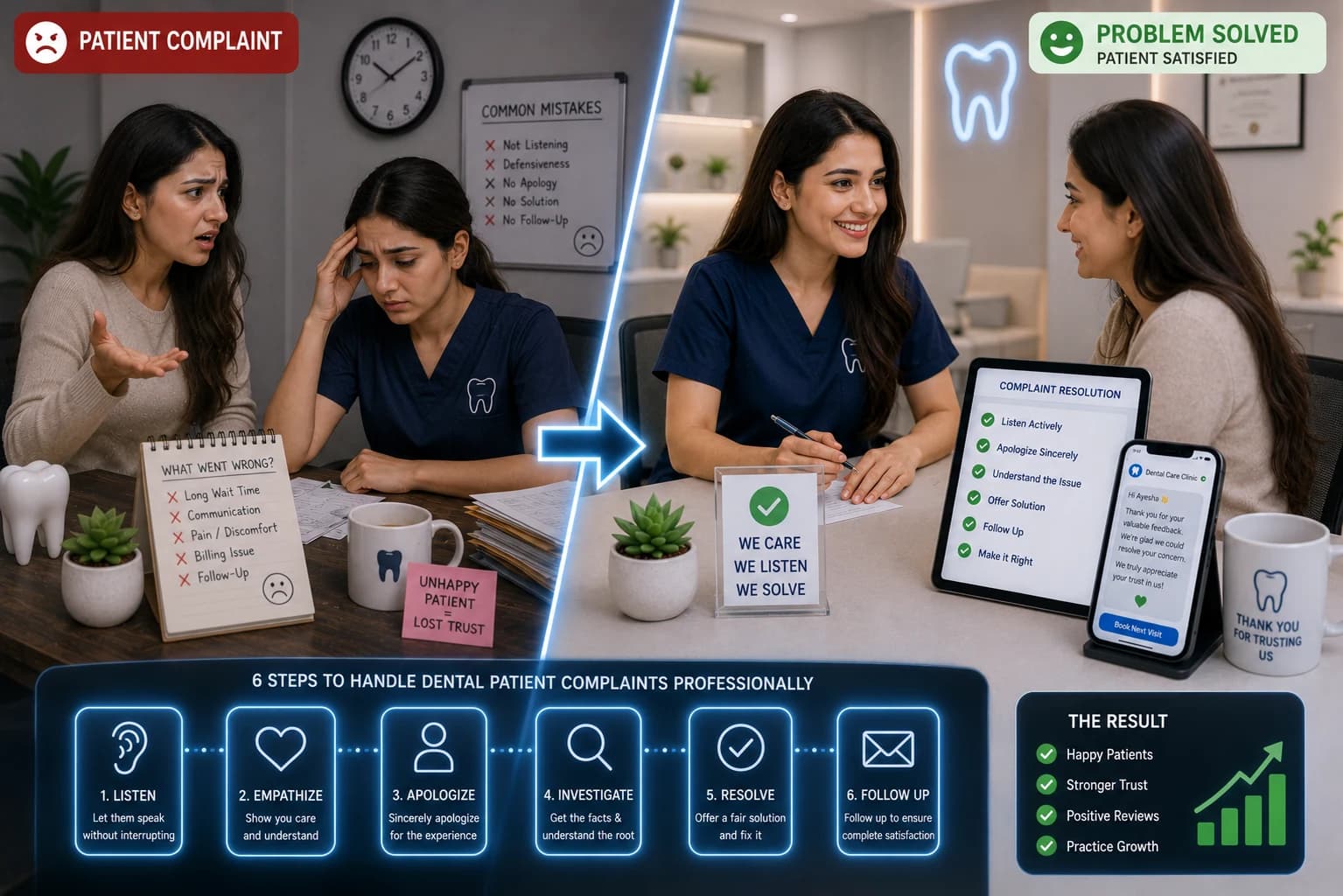
Handle dental patient complaints with the LEARN framework: Listen, Empathize, Apologize, Resolve, Notify. Research shows 70% of patients stay with a provider when issues are addressed promptly — rising to 95% with immediate resolution. Document every complaint, respond within 24 hours, and use billing and treatment records to settle disputes with facts, not memory.
An angry patient at the front desk is not a crisis — it is a fork in the road. Handle the complaint well and research shows up to 95% of patients stay loyal; handle it badly and they leave, then tell others why. Complaints are one of the seven major problems every dental clinic faces, yet most clinics have no written process for them.
This playbook covers the four complaint types you will actually see, a 5-step resolution framework your whole team can run, and when to respond to public reviews.
Key takeaways
- Most dental complaints fall into four buckets: billing disputes, wait times, treatment outcomes, and communication gaps
- Use the LEARN framework — Listen, Empathize, Apologize, Resolve, Notify — so every staff member handles tense moments the same way
- Prompt resolution keeps about 70% of unhappy patients; immediate resolution keeps up to 95% (patient service recovery research)
- Digital billing history and treatment records turn disputes into facts checks, not arguments
- Respond publicly to reviews only with a short, polite, non-clinical reply — then move the conversation private
- Log every complaint and review patterns monthly; repeated complaints are a systems problem, not a patient problem
The Four Complaint Types (and What Each One Really Means)
Complaints feel personal, but they cluster into predictable categories. Each category has a different root cause and a different fix.
| Complaint type | What the patient says | Usual root cause | First response |
|---|---|---|---|
| Billing dispute | "I was never told it would cost this much" | No written estimate; unclear invoice | Pull invoice + payment history |
| Wait time | "My appointment was at 5, it is now 5:40" | Overbooking; no buffer time | Apologize + give honest ETA |
| Treatment outcome | "It still hurts" / "It does not look right" | Expectation gap; missing consent notes | Book priority review with dentist |
| Communication | "Nobody called me back" | No follow-up ownership | Assign one owner + deadline |
Notice the pattern: almost none of these start as clinical failures. They start as documentation and communication failures — which means they are preventable.
Billing disputes deserve special attention
Money complaints escalate fastest and damage trust the most. The fix is structural: itemized invoices, written estimates before treatment starts, and a visible record of every partial payment. When the front desk can show the patient exactly what was quoted, treated, and paid — line by line — most disputes end in minutes. If your billing still lives in a register book, that paper trail does not exist when you need it.
The LEARN Framework: 5 Steps for Any Complaint
Hospitality and healthcare teams worldwide use LEARN because it works under pressure. Train every staff member on it — not just the manager.
Step 1: Listen
Let the patient finish without interrupting, defending, or explaining. Take notes visibly. Most upset patients calm down significantly just from being heard fully. Interrupting restarts the anger cycle.
Step 2: Empathize
Acknowledge the frustration before addressing the facts. "I understand — waiting 40 minutes after a long day is genuinely frustrating." Empathy is not admitting fault; it is recognizing the experience.
Step 3: Apologize
Apologize for the experience, sincerely and early. A 2009 study found 45% of customers will forgive a service failure after a genuine, timely apology (service recovery research summary). For clinical concerns, apologize for the discomfort and route to the dentist — do not debate clinical outcomes at the front desk.
Step 4: Resolve
Offer a concrete fix with a deadline: a corrected invoice today, a priority slot tomorrow, a call from the dentist by 6 PM. Vague promises ("we will look into it") are where complaints go to fester. If the resolver is not the person at the desk, name who will act and by when.
Step 5: Notify (follow up)
Within 48 hours, confirm the fix happened and ask if the patient is satisfied. This closing loop is what converts a complaint into loyalty. A short WhatsApp message works: "Salam — following up on Tuesday. Your corrected invoice was sent and your review appointment is Thursday 4 PM. Does that resolve things for you?"
Why Well-Handled Complaints Increase Retention
It sounds backwards, but the service recovery paradox is well documented: patients whose problems are resolved well often end up more loyal than patients who never had a problem (Harvard Business Review on turning angry customers loyal).
The numbers back it up. Roughly 70% of patients continue with a healthcare provider when issues are addressed promptly — jumping to about 95% when resolution is immediate. A rapid review of medico-legal literature also found that structured communication and resolution programs reduce both the number and the cost of complaints and claims against clinicians (BMC rapid review).
Compare that with the alternative: a lost patient takes their lifetime value, their family's visits, and their referrals — and may leave a one-star review on the way out.
Responding to Public Reviews: A Decision Rule
Online complaints need a different playbook because the audience is everyone who reads the review later, not just the reviewer.
| Review situation | Respond publicly? | What to say |
|---|---|---|
| Factual, polite criticism | Yes | Thank them, acknowledge, invite private follow-up |
| Billing or clinical detail mentioned | Yes — carefully | Generic reply only; never confirm patient details |
| Abusive or fake review | No public debate | Flag with the platform; reply once, neutrally |
| Positive review with a small gripe | Yes | Thank them and note the fix |
Two rules are non-negotiable. First, never confirm someone is a patient or discuss their treatment publicly — patient confidentiality applies even when they shared details first. Second, keep public replies to three sentences and move the conversation to a phone call or WhatsApp. Future patients judge you on the tone of the reply, not the content of the complaint.
Build a Complaint Log (and Read It Monthly)
A complaint handled is good; a complaint pattern fixed is better. Log every complaint with five fields: date, patient, type, resolution, and days-to-resolve.
Then review monthly and ask one question: what keeps repeating? Three wait-time complaints in a month is a scheduling design problem — your slots may need buffer time and better front-desk training, not three more apologies. Repeated billing disputes mean estimates are not being given in writing. The log turns anecdotes into operations decisions.
Prevention: The Complaints You Never Receive
The cheapest complaint is the one that never happens. Most prevention comes down to setting expectations early and documenting everything:
- Written estimates before treatment — the single biggest billing-dispute killer
- Realistic scheduling with buffer time, so 5 PM means 5 PM
- Digital treatment records patients can trust — transparent medical reports build trust before doubts appear
- Appointment confirmations and reminders so nobody arrives on the wrong day
- One named owner for every follow-up promise made at the desk
Pakistan Clinic Context
In Pakistani clinics, complaints rarely arrive through a formal channel — they come as a WhatsApp voice note, a word with the receptionist, or a family member's phone call. That informality cuts both ways: patients escalate quietly to relatives and neighbourhood word-of-mouth long before they write a Google review. Treat WhatsApp as your official complaints channel: acknowledge there, resolve there, and follow up there in Urdu or English, whichever the patient used. A clinic that replies on WhatsApp within the hour is already ahead of most competitors.
Denzif helps make complaint resolution factual instead of emotional: every invoice, partial payment, appointment status, and treatment note sits in one patient record, so the front desk can answer a billing dispute with the actual history in seconds. After resolution, a WhatsApp follow-up message closes the loop and rebuilds trust on the channel Pakistani patients actually read.
The Bottom Line
Complaints are not a reputation threat — unhandled complaints are. Run the LEARN framework, resolve within 48–72 hours, and follow up every time: prompt resolution keeps around 70% of unhappy patients and immediate resolution keeps up to 95%. Log patterns monthly and fix the system behind repeat complaints, because the same failure apologized for twice is a choice.
About Denzif
Denzif is cloud dental practice management for established small-to-mid clinics in Pakistan — patients, appointments, treatments, billing, inventory, WhatsApp reminders, and optional AI on Standard. Get custom PKR pricing or request a private walkthrough.
Frequently Asked Questions
The big four are billing disputes (unexpected charges or unclear invoices), long wait times, dissatisfaction with treatment outcomes, and poor communication. Most complaints trace back to a gap between what the patient expected and what the clinic documented or explained — not to clinical negligence.
Ready to put this into practice?
Custom PKR pricing for established clinics. Private walkthrough after we confirm fit. Setup in about 15 minutes.