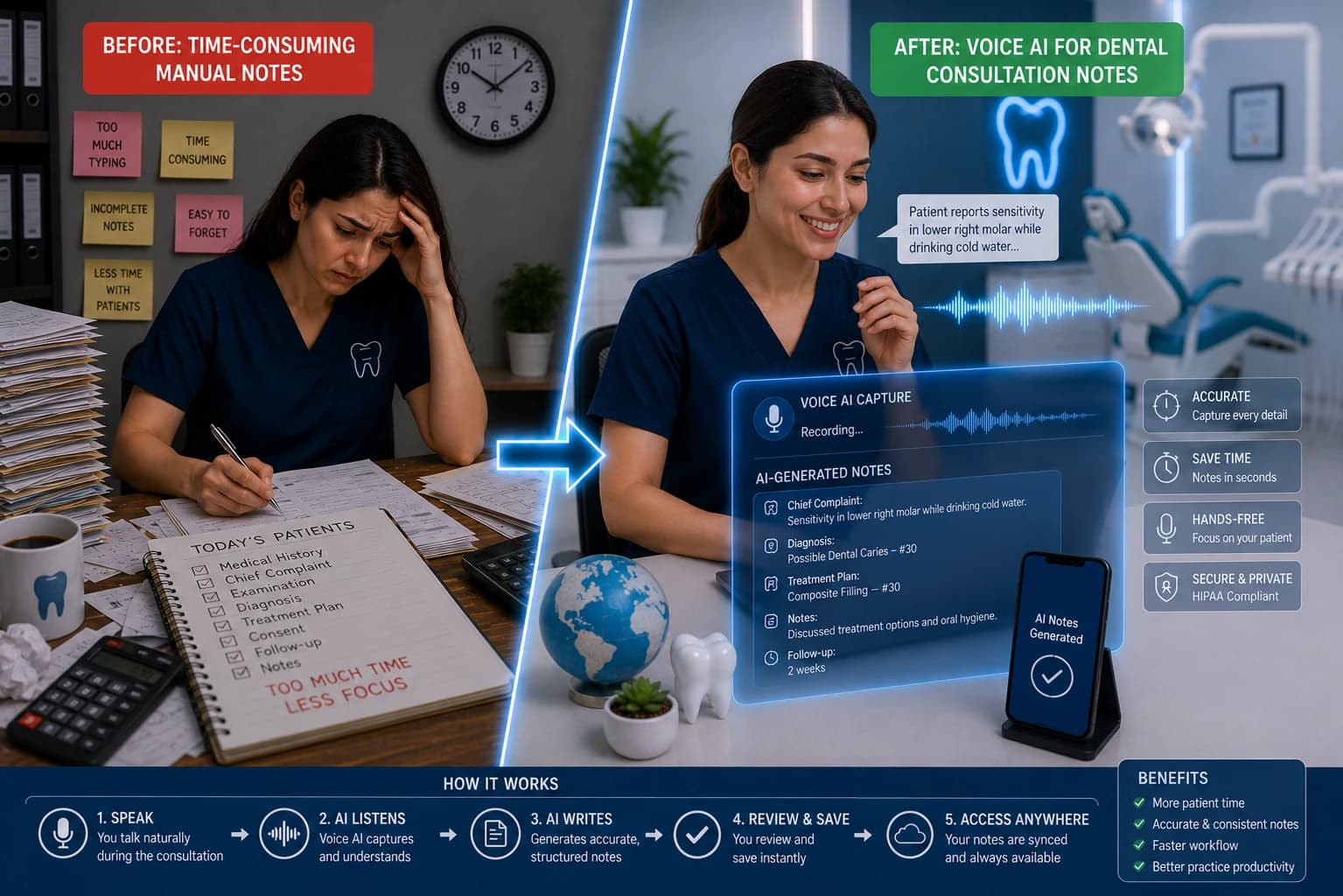
Voice AI for Dental Consultation Notes: How It Works (2026 Guide)
Voice AI turns chairside dictation into structured dental notes in minutes — not after closing. Learn how ASR works, what to verify, and how Denzif AI fits your workflow.
Quick answer
Voice AI for dental consultation notes uses automatic speech recognition (ASR) to transcribe chairside dictation into structured chart entries — typically saving 30–40% of documentation time per visit. Denzif AI plan includes voice-to-text in the clinic admin assistant; dentists review and save notes to the patient record before signing off.
You finish a consultation, glance at the waiting room, and realize twelve patients still need chart entries before you leave. Typing between chairs is how dentists lose evenings — and how notes drift from what you actually said chairside.
Voice AI fixes the bottleneck: you speak; software transcribes and structures the note; you review in under a minute. This guide explains how the technology works, what to verify before adoption, and where Denzif fits for Pakistan clinics moving beyond paper and WhatsApp forwards.
Key takeaways
- Voice AI uses ASR (automatic speech recognition) plus structuring rules to draft chart notes from dictation.
- Typical time savings: 30–40% less documentation labor when dictation replaces typing.
- Dentist review is mandatory — AI drafts; the clinician signs the final record.
- Denzif AI plan includes voice-to-text in the clinic admin assistant — see AI dental software.
- Separate from imaging AI — documentation AI is lower risk and faster ROI for small clinics.
- Pro trial does not include AI; evaluate voice on the AI plan walkthrough.
The documentation problem in 2026
Time cost is measurable
McKinsey research on healthcare productivity consistently ranks clinical documentation among the top administrative burdens on providers. In dentistry, each incomplete note creates downstream risk: billing disputes, weak treatment plans, and recall gaps.
Roughly one in three dentists in Canada, the US, and UK now uses at least one AI tool — documentation and admin layers are growing faster than pure imaging AI among independents (Oral Health Group, 2026).
Paper and memory fail under volume
Paper registers and end-of-day batch typing produce notes that do not match chairside findings. Voice capture at the moment of care — while tooth numbers and materials are fresh — improves accuracy and speeds billing linkage.
How voice AI for dental notes works
Step 1: Capture audio
The dentist uses a headset, clinic mic, or mobile device near the operatory. Short dictation bursts (30–90 seconds) work better than ten-minute monologues.
Step 2: Speech-to-text (ASR)
ASR models convert audio waveforms to text. Medical-tuned models handle terms like "periodontal," "MOD," and brand names better than generic consumer dictation.
Step 3: Structure into chart sections
Raw transcript is not a clinical note. Software maps text into:
- Chief complaint and history
- Clinical findings (by tooth / quadrant)
- Diagnosis and treatment plan
- Materials and procedures performed
- Follow-up and recall interval
Step 4: Clinician review and save
The dentist edits, confirms tooth numbers, and saves to the digital patient record. Nothing is final until a licensed provider approves.
Typical flow: Patient exam → dentist dictates findings → ASR transcribes → AI structures sections → dentist reviews and edits → saved to chart → invoice and treatment linked.
Voice AI vs other documentation options
| Method | Monthly cost (indicative) | Speed | Accuracy control |
|---|---|---|---|
| Typing between patients | Staff time only | Slow | High if done immediately |
| Human scribe | $2,500–$4,500/mo | Fast | High |
| Voice AI (bundled PMS) | $29–$47/mo add-on tier | Fast | Medium-high with review |
| Standalone dictation (Dragon, etc.) | $100–$300/mo | Medium | High with training |
Bundled AI dental software wins when transcription lives inside the same system as scheduling and billing — no copy-paste between apps.
What to verify before you buy
Clinical vocabulary
Ask vendors for a demo using your procedure mix — implants, endo, pediatric, ortho referrals. Generic demos hide failure on tooth numbering and material codes.
Language and accent support
Pakistan clinics often switch Urdu and English mid-sentence. Test ASR with your actual staff voices, not a Silicon Valley accent sample.
Data handling
Confirm: where audio is processed, how long recordings are retained, who can access transcripts, and whether data trains third-party models. See patient privacy practices.
Integration depth
Best outcome: voice note → treatment record → invoice line item in one flow. Standalone dictation that dumps text into a Word file recreates the copy-paste problem.
Denzif voice workflow (AI plan)
Denzif AI (optional AI billed with your clinic plan) includes voice-to-text in the clinic admin AI assistant:
1. Open AI chat during or after consultation
2. Tap microphone and dictate findings
3. ASR transcribes via secure API
4. Copy structured text into treatment notes on the patient chart
5. Link treatment to billing as usual
This sits alongside AI agents for recall, follow-up, and payment reminders — one platform, not five subscriptions. Full feature list: AI dental software.
Important: Message Denzif on WhatsApp for an AI evaluation if voice is your primary use case. Voice features are billed with your clinic plan.
Dictation tips that improve output
Use a fixed verbal template
Example script:
"Patient [name], visit type [new/returning]. Chief complaint: [ ]. Exam: tooth 14 MOD caries, cold sensitive. Plan: composite restoration, estimate [amount]. Recall six months hygiene."
Templates train you as much as the model — consistency beats clever prose.
Dictate before you stand up
Notes dictated within two minutes of exam match reality. Notes at 9 PM match memory — and billing errors.
Mark uncertainty explicitly
Say "possible periapical lesion tooth 36 — confirm with PA" instead of guessing. AI will transcribe what you say; clinical judgment stays yours.
Risks and limitations
Over-reliance without review
AI can mishear homophones ("mesial" vs "missile" in bad audio). Never sign a note you did not read.
Operatory noise
High-speed handpieces and assistants talking degrade accuracy. Dictate in the consult room or use a directional mic.
Regulatory and consent
Inform patients that voice documentation may be used. Store records under the same access controls as written charts.
Pakistan clinic context
- WhatsApp-first patients expect fast documentation too — voice notes let you reply to queries with chart facts without digging through paper.
- Load-shedding favors cloud ASR over local server dictation — your phone mic works when the desktop UPS dies.
- Associate dentists with uneven typing speed get consistent note quality when everyone uses the same verbal template.
- Start with AI admin chat for schedule summaries before chairside dictation — builds trust in the AI plan without clinical risk on day one. Read how AI is changing dentistry in Pakistan.
14-day rollout plan
Days 1–3: Enable AI plan trial; test transcription in quiet office with three mock cases.
Days 4–7: One dentist dictates all new exams; compare note completion time vs prior week.
Days 8–10: Add treatment-plan dictation; link notes to invoices same day.
Days 11–14: Train associates on template; measure incomplete charts at day-end (target: zero).
Pair with digital tooth charting so dictated findings map to visual charts patients understand.
The Bottom Line
Voice AI for dental consultation notes is not science fiction — it is ASR plus structured templates with a mandatory dentist review step. Clinics save 30–40% documentation time when dictation replaces typing between patients, and bundled platforms avoid the copy-paste tax of standalone dictation tools.
Start with one provider, one verbal template, and fourteen days of measured note-completion time. If evenings stop being "chart catch-up hour," expand to the full team.
About Denzif
Denzif is cloud dental practice management for established small-to-mid clinics in Pakistan — patients, appointments, treatments, billing, inventory, WhatsApp reminders, and optional AI on Standard. Get custom PKR pricing or request a private walkthrough.
Frequently Asked Questions
The dentist speaks findings during or immediately after the exam. A microphone captures audio; automatic speech recognition (ASR) converts speech to text; the software structures output into sections (chief complaint, findings, plan). The clinician reviews, edits, and saves to the patient chart — AI drafts; the dentist approves.
Ready to put this into practice?
Custom PKR pricing for established clinics. Private walkthrough after we confirm fit. Setup in about 15 minutes.