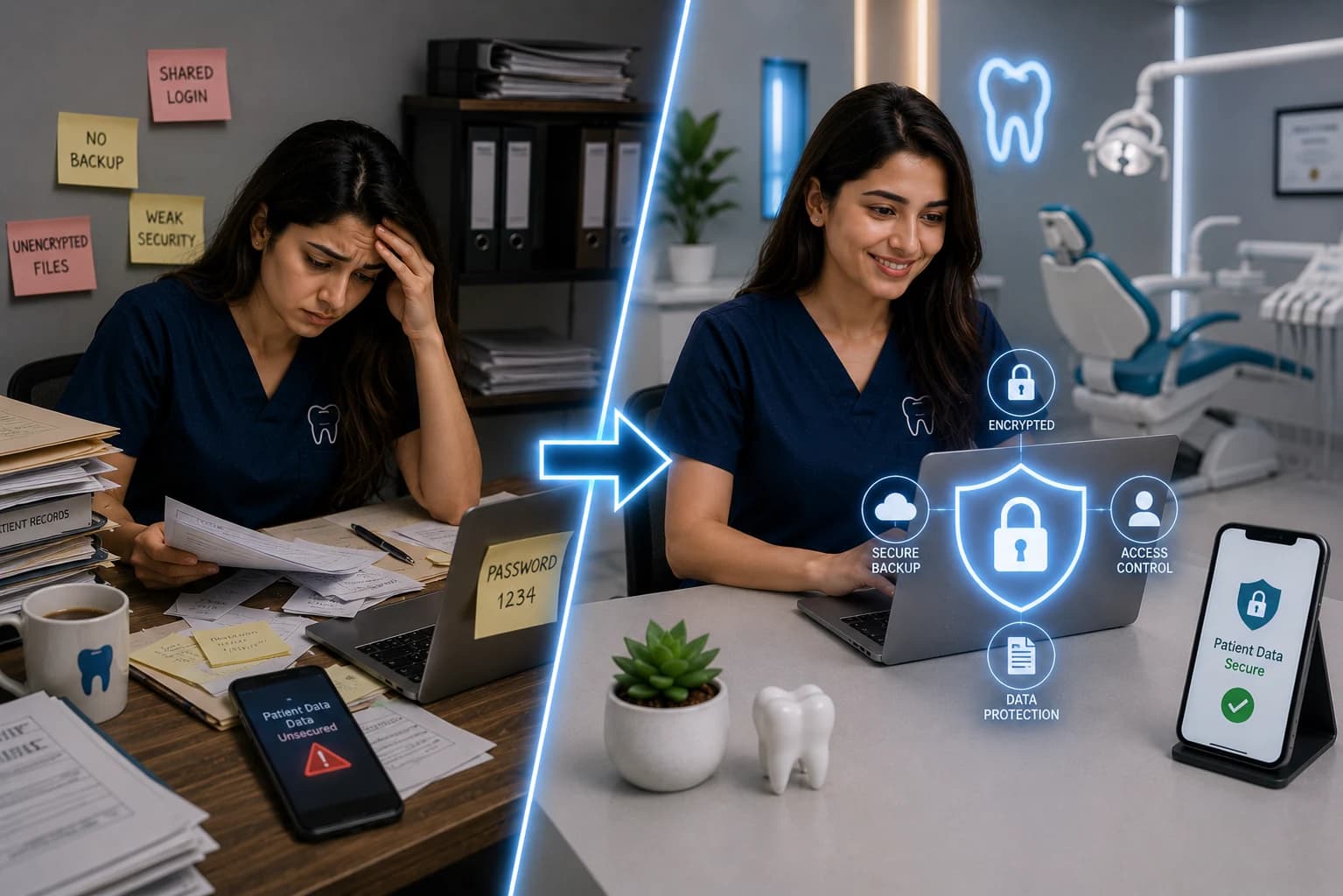
How to Maintain Patient Privacy & Data Security in Your Dental Clinic
Healthcare breaches cost $7.42M on average and small clinics are easy targets. A practical privacy checklist: access roles, backups, and vendor questions.
Quick answer
Protect dental patient data by ending shared logins, locking away paper charts, moving WhatsApp to an official business number, and running daily encrypted backups. Healthcare remains the costliest breach industry at $7.42 million per incident, and small clinics with weak access controls are soft targets. Role-based permissions and vendor security questions close most gaps.
A dental record is one of the most complete identity files a person has: CNIC, phone number, address, medical history, and payment details in one place. That is why healthcare has been the costliest industry for data breaches for 14 consecutive years, averaging $7.42 million per incident (IBM Cost of a Data Breach 2025).
Small clinics often assume they are too small to matter. The opposite is true — weak access controls, shared logins, and unprotected paper charts make them the easiest targets, and the trust damage from one leaked record can undo years of patient relationship building.
Key takeaways
- Healthcare breaches cost $7.42 million on average — the costliest of any industry for 14 straight years
- In 2025, 710 large healthcare breaches exposed records of nearly 61 million people
- The five most common clinic failures: visible paper charts, shared logins, personal-phone WhatsApp, no backups, and ex-staff access
- Role-based access (admin vs receptionist) stops most internal leaks before they start
- Daily automatic backups are the difference between a bad day and a closed practice
- Ask every software vendor eight specific security questions before signing anything
Why Dental Patient Data Is Worth Stealing
Attackers value patient files because they bundle identity, contact, medical, and financial data that cannot be cancelled like a credit card. The HIPAA Journal 2025 breach report counted 710 large healthcare breaches in a single year, exposing protected health information of almost 61 million individuals.
The breakdown of where data leaked is instructive for clinics of any size:
| Breach location | Share of 2025 incidents |
|---|---|
| Network servers | 61.5% |
| Compromised email accounts | 24.9% |
| Paper records and films | 5.6% |
| Electronic medical record access | 4.6% |
Two lessons stand out. First, email is a quarter of the problem — sending patient lists as spreadsheet attachments is a breach waiting to happen. Second, paper is not safe by default; physical records still account for a meaningful share of incidents.
The 5 Most Common Privacy Failures in Small Clinics
None of these require a hacker. They are everyday habits that quietly expose patient data.
| Failure | Why it happens | What goes wrong |
|---|---|---|
| Paper charts at the front desk | Convenience during busy hours | Any visitor can read names, conditions, balances |
| One shared software login | Nobody set up individual accounts | No audit trail; password known by every ex-employee |
| WhatsApp from personal phones | Staff use what they already have | Patient chats live in personal histories forever |
| No working backups | Backups were manual and stopped | Ransomware or a dead hard drive ends the record system |
| Ex-staff access never revoked | No offboarding checklist | A resigned receptionist can still read patient files |
The shared login problem deserves special attention
When five staff members use one password, you cannot answer the most basic security question: who looked at this record? Every staffing change should mean a password change, but with shared logins it never does. Individual accounts with defined roles fix this in an afternoon.
Personal WhatsApp is the silent leak
Patients in Pakistan expect WhatsApp communication — that part is correct. The mistake is routing it through personal numbers. When that staff member leaves, every patient conversation, photo, and report they ever received leaves with them. An official WhatsApp Business API connection keeps messages on a clinic-owned number with central logging.
A Practical Privacy Checklist for Small Clinics
You can complete this list in one week without an IT consultant:
1. Move paper charts out of patient sightlines; lock filing cabinets outside working hours
2. Create an individual login for every staff member; delete the shared one
3. Assign roles so reception staff see schedules and contacts, not exports and finances
4. Switch patient messaging to an official clinic WhatsApp number, never personal phones
5. Confirm backups run daily and automatically — then actually test one restore
6. Write a 5-line offboarding checklist: revoke software access, change shared passwords, collect keys
7. Stop emailing patient lists as attachments; share access inside the system instead
8. Position screens so waiting patients cannot read other patients' details
Print it, assign each line an owner, and review it quarterly. Privacy is a routine, not a project.
Role-Based Access: Who Should See What
The principle is simple: each role gets the minimum access its job requires. A sensible split for a small clinic looks like this:
| Capability | Clinic admin | Receptionist |
|---|---|---|
| Book and reschedule appointments | Yes | Yes |
| View patient contact details | Yes | Yes |
| View full treatment and medical history | Yes | Limited |
| Create and send invoices | Yes | Yes |
| View revenue reports and analytics | Yes | No |
| Export patient data | Yes | No |
| Change clinic settings and staff accounts | Yes | No |
This is not about distrusting staff. It is about limiting the blast radius of one phished password or one disgruntled departure. If the receptionist's account is compromised, the attacker gets a schedule — not your entire patient database.
Backups: The "What If Tomorrow" Test
Ask one question: if the clinic computer died tonight, what would you still have tomorrow morning? If the honest answer is "nothing" or "a backup from four months ago," that is the single most urgent fix on this list.
Good backup practice has three parts: daily, automatic, and tested. Manual backups decay because someone forgets; untested backups fail exactly when you need them. Cloud-based systems handle this invisibly — we covered the full reasoning in why daily backups matter for dental clinics.
Healthcare breaches also take the longest of any industry to detect and contain — 279 days on average (IBM 2025 data). For a small clinic, that means damage can accumulate for months before anyone notices. Backups do not prevent a breach, but they guarantee you never lose the records themselves.
8 Questions to Ask Any Software Vendor
Before trusting any system with patient data, get written answers to these:
1. Where is our data physically stored, and who can access the servers?
2. Is data encrypted both at rest and in transit?
3. How often do backups run, and how do you test restores?
4. Does every staff member get an individual login?
5. Can we limit what receptionists see versus admins?
6. Is our clinic's data isolated from other clinics on the platform?
7. Is WhatsApp messaging handled through the official Business API?
8. If we leave, how do we export all our data?
A serious vendor answers all eight without hesitation. Denzif's answers: patient data lives in encrypted cloud storage with daily automatic backups, every staff member gets role-based access (clinic admin versus receptionist), each clinic's data is fully isolated from every other clinic on the platform, and patient messaging runs through the official WhatsApp Business API on a clinic-owned number. The full detail is on our security page.
This matters even more as clinics adopt AI-assisted tools in Pakistani dentistry — every new capability is also a new place where data handling must be done right.
Pakistan Clinic Context
Pakistan does not yet enforce a comprehensive personal data protection law, and the draft Personal Data Protection Bill has circulated for years without final passage. That means no regulator will force your clinic to protect patient data — but patients will. In cities where clinics compete block by block, "they keep my information safe" is a referral reason, and one leaked WhatsApp screenshot of a patient file travels faster than any advertisement. Load-shedding adds a local twist: clinics relying on a single on-premise computer risk both data loss and downtime, which is why cloud-hosted systems with daily backups fit Pakistani operating conditions better than office servers.
The Bottom Line
Patient privacy in a dental clinic is mostly habits, not hardware. The five common failures — visible charts, shared logins, personal-phone WhatsApp, missing backups, and lingering ex-staff access — are all fixable in a week. With healthcare breaches averaging $7.42 million and 61 million patient records exposed in 2025 alone, the cheapest time to fix them is before anything happens.
About Denzif
Denzif is cloud dental practice management for established small-to-mid clinics in Pakistan — patients, appointments, treatments, billing, inventory, WhatsApp reminders, and optional AI on Standard. Get custom PKR pricing or request a private walkthrough.
Frequently Asked Questions
Patient records combine identity data (CNIC, phone, address, date of birth) with medical and payment history — a package worth far more than a stolen card number. Healthcare has been the costliest breach industry for 14 consecutive years, averaging $7.42 million per incident, because this data fuels identity theft and fraud.
Ready to put this into practice?
Custom PKR pricing for established clinics. Private walkthrough after we confirm fit. Setup in about 15 minutes.