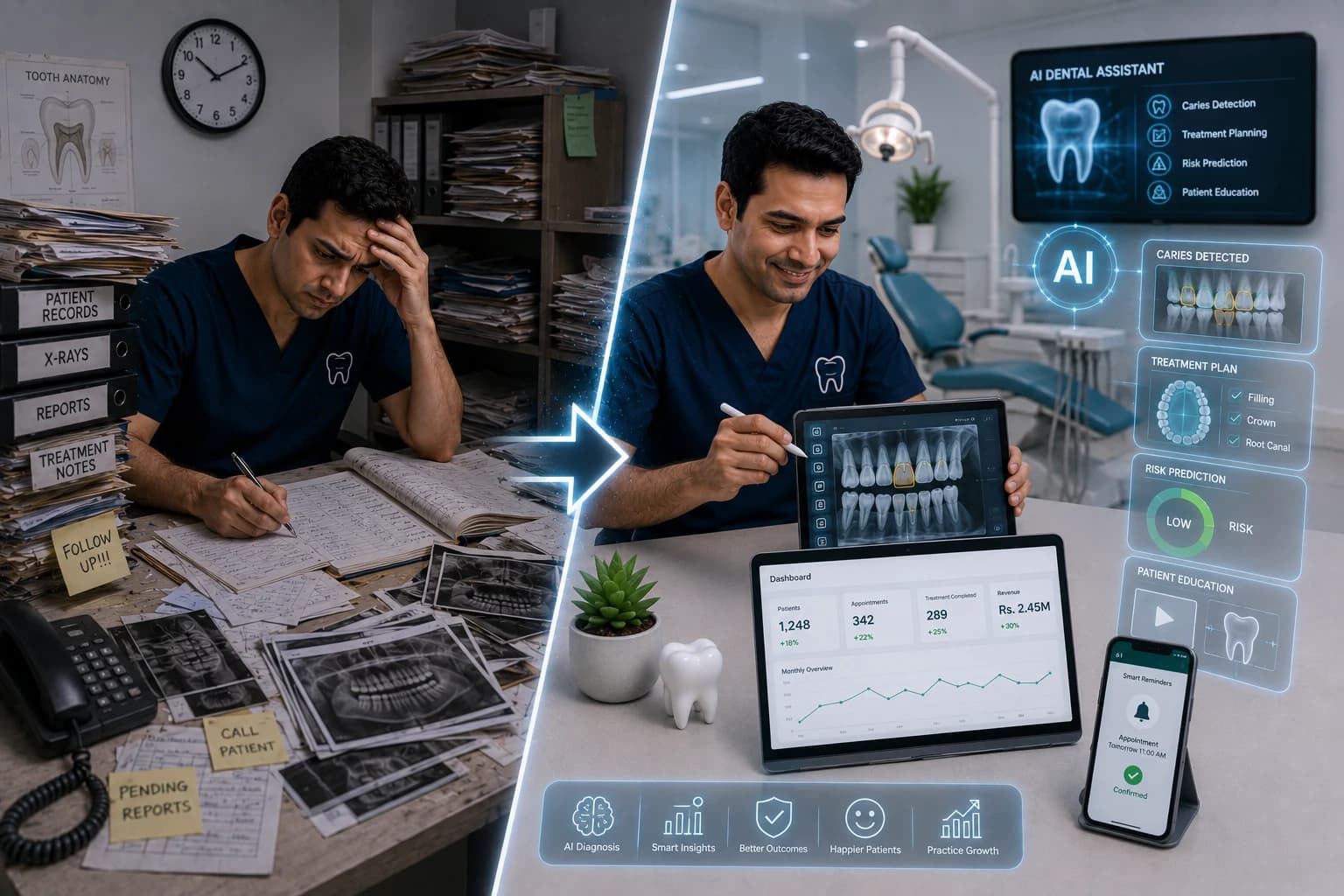
How AI is Changing Dentistry in Pakistan (Real Examples)
One in three dentists now use AI globally — but only 12% of students get formal training. See real clinic use cases in Pakistan: charting, reminders, admin chat, and what to adopt first in 2026.
Quick answer
In Pakistan clinics, practical AI dentistry starts with WhatsApp reminders and admin chat — not imaging AI. Denzif's AI plan adds recall, follow-up, and payment agents; the Pro trial does not include AI features.
Your receptionist spends twenty minutes reconciling tomorrow's schedule across a notebook, Excel, and WhatsApp forwards. Meanwhile, one in three dentists in North America, Canada, and the UK already uses at least one AI-powered tool in practice — and 38% more are actively considering adoption (Dental Reviewed / Oral Health Group, 2026).
In Pakistan, the story is different but accelerating: urban clinics are skipping the "paper decade" and jumping straight to cloud practice management, WhatsApp automation, and admin AI that answers "who is overdue for hygiene?" in seconds. Clinical imaging AI is coming next — but the biggest wins in 2026 are often operational, not robotic dentistry.
This article explains what AI actually does in clinics today, real examples relevant to Pakistani practice owners, and a 90-day adoption path that does not require a hospital IT budget — building on your digital patient records and WhatsApp reminder stack.
The Global Picture: Where Adoption Stands in 2026
AI in dentistry is no longer experimental at the enterprise level. Heartland Dental's VideaHealth rollout across 2,300+ practices reported 95%+ daily clinician usage and measurable early-decay treatment from AI-flagged radiographs (DSO News, 2026).
For the average private clinic, the numbers look like this:
| Metric | Benchmark (2025–2026) | Source |
|---|---|---|
| Dentists using ≥1 AI tool | 32–35% | Dental Reviewed; WiFiTalents market report |
| Considering adoption | 38% | Dental Reviewed survey |
| AI users applying it to radiographs | 82% | Dental Reviewed |
| Trust AI over own judgment | ~2% | Dental Reviewed |
| View AI as "helpful second opinion" | 52% | Dental Reviewed |
| Report improved case acceptance after AI | 44% of AI users | Dental Reviewed (self-reported) |
| Global AI-in-dentistry market by 2030 | $2.7B–$10.4B | Multiple market analyses |
The gap is training: only 12.5% of dental students report formal AI training in school, while 77% of professionals believe AI will have high impact on the industry (WiFiTalents, 2026). Pakistani graduates face the same curve — motivated owners learn on the job.
Five AI Categories — And What Each Does in a Real Clinic
1. Diagnostic imaging AI (radiographs)
What it does: Flags interproximal caries, bone loss, and some pathologies on bitewings and OPGs faster than the naked eye alone.
Who benefits: High-volume practices with digital radiography and consistent imaging protocols.
Caveat: Dentists still verify every finding; regulatory clearance varies by product. Poor integration causes 40% of adopters to abandon tools within three months — usually due to cost and PMS friction, not accuracy alone (Dental Reviewed, 2026).
2. Treatment planning & case presentation AI
What it does: Visualizes proposed care, compares outcomes, and supports phased plans — often tied to digital tooth charting.
Revenue link: DSO deployments report 10–15% treatment acceptance lifts when AI visuals are used consistently in case presentation (DSO News, 2026).
3. Administrative & practice AI (fastest win for Pakistan)
What it does: Answers staff questions ("patients with balance over 5,000 PKR"), drafts recall lists, summarizes schedules, transcribes voice notes.
Why it fits Pakistan: Load-shedding, multi-dentist handoffs, and high WhatsApp volume make searchable digital records + AI admin more valuable than another standalone gadget.
4. Patient communication automation
What it does: Template and session WhatsApp reminders, booking links, follow-ups — not generative "chatbot dentists," but rules-based automation with high deliverability.
Impact: Tied directly to no-show cost reduction; practices using structured multi-touch reminders often cut no-shows 38–50%.
5. Analytics & revenue intelligence
What it does: Surfaces production per chair, overdue hygiene, and pending treatment — the inputs for increasing revenue without new chairs.
Industry estimates suggest AI-assisted scheduling and admin can save 2.5+ hours per week per practice and reduce diagnostic workflow time up to 50% in imaging-heavy offices (ZipDo digital transformation stats, 2026).
Real Examples: What Pakistani Clinics Are Doing Now
These patterns appear in Lahore, Islamabad, Karachi, and Faisalabad multi-chair clinics using modern PMS — not science fiction.
Example A — Admin AI for the morning huddle
Before: Owner manually counts today's RCT slots, pending labs, and balances.
After: Staff asks the clinic AI: "List patients with unpaid invoices over 3,000 PKR coming today" or "Who has not rebooked hygiene in 12 months?"
Result: Huddle drops from 25 minutes to 10; collections conversations start before the first patient sits.
Example B — Voice-to-note after long procedures
Before: Dentist stays 40 minutes after close writing notes from memory.
After: Dictation transcribed into structured progress notes linked to the patient chart.
Result: Same-day chart closure improves; fewer billing disputes from missing procedure codes.
Example C — WhatsApp + AI scheduling rules
Before: Receptionist copies numbers from paper and sends generic reminders.
After: System sends PKT-aware reminders with confirm/reschedule prompts; failed numbers flagged as invalid WhatsApp.
Result: Fewer empty chairs without hiring another front-desk person — see WhatsApp automation guide.
Example D — Imaging AI in a specialty-heavy clinic
Before: Missed early interproximal lesions on busy hygiene days.
After: AI highlights suspicious areas; dentist confirms and documents.
Result: More phased restorative plans accepted when shown chairside — aligns with global 22% average case acceptance lift cited for AI-assisted workflows in market surveys (WiFiTalents, 2026).
What to Adopt First: A 90-Day Roadmap
| Phase | Weeks | Focus | Success metric |
|---|---|---|---|
| Foundation | 1–4 | Digital records, one patient ID, mandatory phone format | Chart retrieval under 30 seconds |
| Communication | 5–8 | WhatsApp reminders + recall lists | No-show rate down 20%+ |
| Admin AI | 9–10 | Staff trained on clinic AI assistant | 2+ hours/week admin time saved |
| Clinical AI (optional) | 11–13 | Imaging AI pilot on digital X-rays | Documented second-read workflow |
| Scale | Ongoing | Analytics + case presentation standard | Case acceptance +10 pts |
Do not buy imaging AI before your patient records are trustworthy — garbage in produces expensive garbage out.
Barriers — And Honest Answers
| Barrier | Reality | Mitigation |
|---|---|---|
| High cost | Enterprise AI is pricey | Bundle via PMS; start with admin + reminders |
| Poor PMS integration | #1 reason for abandonment | Choose platforms with native AI, not 5 logins |
| No training | 12.5% student exposure | Weekly 15-min staff drills |
| Patient trust | Patients fear "robot dentist" | Explain AI as support; dentist decides |
| Power / internet | Local servers fail | Cloud PMS + mobile browser access |
Pakistan Context: Regulation, Language, and Workflow
- Language: Admin AI should handle Urdu and English queries; patient-facing messages often work best in Urdu with English for invoices.
- Payments: AI should surface partial payments and cash habits, not only card — critical for billing workflows.
- Privacy: Do not upload CNIC, scans, or full charts into public LLMs. Use clinic-scoped AI inside your PMS.
- Multi-dentist: AI summaries must filter by dentistId and chair — same discipline as multi-chair scheduling.
The Bottom Line
32% of dentists already use AI clinically; 82% of them start with radiographs — but Pakistani clinics win faster by fixing records, reminders, and admin intelligence first. Practices that layer AI on organized data report 10–22% better case acceptance, hours saved weekly, and fewer abandoned software rollouts.
AI is not replacing dentists in 2026. It is replacing sticky notes, guesswork, and empty chair time — if you adopt it in the right order.
About Denzif
Denzif is cloud dental practice management for established small-to-mid clinics in Pakistan — patients, appointments, treatments, billing, inventory, WhatsApp reminders, and optional AI on Standard. Get custom PKR pricing or request a private walkthrough.
Frequently Asked Questions
Global surveys show about 32–35% of dentists use at least one AI tool, with higher adoption in large groups. In Pakistan, urban multi-chair clinics lead with admin AI (scheduling summaries, patient lookup chat), WhatsApp automation, and digital charting — clinical imaging AI is growing but less universal than in North American DSOs.
Ready to put this into practice?
Custom PKR pricing for established clinics. Private walkthrough after we confirm fit. Setup in about 15 minutes.