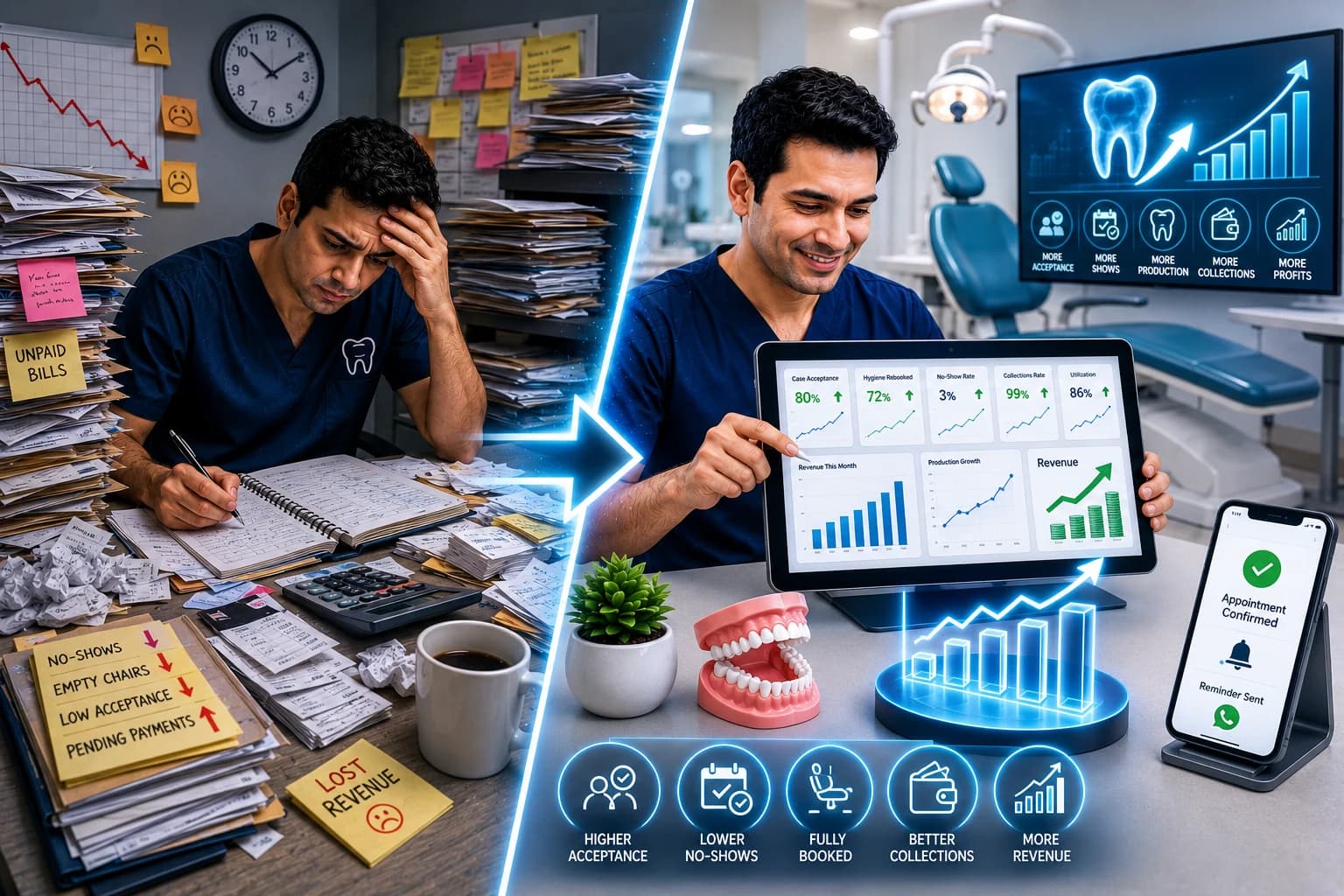
5 Ways to Increase Your Clinic Revenue Without Adding More Chairs
Moving case acceptance from 50% to 80% on $1M presented treatment adds $300K — no new chairs. Five proven levers: acceptance, hygiene recall, schedule fill, no-shows, and collections.
Quick answer
Grow clinic revenue without new chairs by improving case acceptance, WhatsApp recall, schedule fill, and collections. Cloud dental software ties treatments to invoices and reminder workflows.
You do not need another chair, another lease, or another marketing agency to grow — yet most owners chase those first. The math says otherwise: on $1 million in presented treatment annually, moving case acceptance from 50% to 80% adds roughly $200,000–$300,000 in collected revenue with the same team, same chairs, and same hours (Levin Group / Dental Practice Insider benchmarks).
That is not theory. It is the highest-leverage variable in dental profitability — more impactful than doubling new-patient ads if your schedule already has gaps from no-shows, unscheduled hygiene, and pending payments.
Here are five proven levers to increase clinic revenue in 2026 without adding chairs — with formulas, benchmarks, and a Pakistan-ready weekly rhythm.
Lever 1: Raise Case Acceptance (The $300K Lever)
The benchmark
| Performance tier | Case acceptance | On $1M presented |
|---|---|---|
| Needs improvement | Under 40% | Under $400K collected |
| National average | 50–60% | $500K–$600K |
| Above average | 65–79% | $650K–$790K |
| Top performers | 80–90%+ | $800K–$900K+ |
The $200K–$300K gap between average and top tier is almost entirely presentation, financing, and follow-up — not clinical skill.
What works
1. Show, do not only tell — intraoral photos and digital tooth charts so patients see why care is needed.
2. Monthly payment framing — "3,200 PKR per month for six months" beats "19,000 PKR total" for elective care; financing lifts acceptance 15–25% on plans over $1,000 (ADA Health Policy Institute, cited in industry guides).
3. Treatment coordinator or owner follow-up — 60% of high-value cases close after the third contact; most clinics stop after one.
4. Same-day start — schedule the first visit before the patient leaves when clinically appropriate.
30-day action
- Script a 3-touch follow-up (day 0, day 3, day 10) for every plan over your clinic's "high value" threshold.
- Track presented vs accepted weekly in your PMS — not monthly.
Lever 2: Hygiene Reappointment & Recall (Fill the Pipeline)
Hygiene is the engine of future restorative production. Top practices rebook 70%+ of hygiene patients before they leave; average offices book about half, and bottom decile offices under 31% (ThriveCloud practice metrics).
Why it matters
- Patients who leave with the next appointment are far more likely to return.
- Only ~10% cancel or no-show compared to patients on "we'll call you" lists.
- Two-thirds of patients have skipped booking in the past year because scheduling felt like a hassle (MedCity News, cited in ThriveCloud).
What works
| Tactic | Target |
|---|---|
| Book next hygiene in chair | 70%+ same-day reappointment |
| Recall list for overdue 6+ months | Contact within 48 hours of flag |
| WhatsApp recall with one-tap reply | 25%+ response rate |
| Link hygiene findings to treatment plan | Higher restorative conversion |
Connect recall to organized patient records so hygienists see last acceptance and balance before presenting care.
Lever 3: Fill Empty Chair Time (Waitlist + Utilization)
Schedule utilization = filled clinical hours ÷ available hours. Every unfilled hour at $200–$375 lost production is invisible on your P&L until you measure it.
What works
1. Real-time waitlist — when a slot cancels, message 3–5 patients automatically (WhatsApp automation).
2. Short-notice list for scaling, emergencies, and quick fills.
3. Multi-chair discipline — assign chairs to providers; avoid double-booking chaos that forces cancels (multi-dentist scheduling).
4. 17:00 same-day rule — if tomorrow has holes, fix tonight: calls + WhatsApp, not hope.
Formula
If you recover 4 hours per week at $250/hour average production, that is $52,000/year — one hygienist afternoon, no capex.
Lever 4: Cut No-Shows (Recover Lost Production)
Average no-show rates run 15–20%; top practices hit 1–5% with systematic reminders. Annual losses often reach $105,000–$240,000 for a mid-size clinic — detailed in How Much Money Are You Losing Every Month Due to No-Shows?.
Minimum viable reminder stack
| Touch | Timing | Channel |
|---|---|---|
| 1 | At booking | WhatsApp + written policy |
| 2 | 24 hours before | WhatsApp template |
| 3 | 2 hours before | WhatsApp or call for high-value |
| 4 | After no-show | Reschedule + deposit rule |
Practices using multi-channel automated reminders often reduce no-shows 38–50% — pure capacity recovery.
Lever 5: Collect What You Already Produced (Collections Rate)
High production with weak collection is a vanity metric. Target 98–100% collection of current production; sustained over 100% means you are finally collecting old AR.
What works
1. Invoice at chairside — treatment note and bill same day; link to chart.
2. Partial payment capture — record cash, card, and bank transfer immediately; no "pay later" without a plan.
3. AR huddle — weekly list of patients with balance and an appointment in the next 14 days.
4. Deposit policy for chronic no-shows or high-value elective starts.
Clinics that connect clinical notes to billing often recover 2–4% of annual production previously lost to handoff errors — the same range cited in digital records economics.
Stack the Levers: Example Annual Impact
Mid-size clinic assumptions: $8M PKR (~$28K USD monthly) production, 55% acceptance, 18% no-show, 55% hygiene rebook, 92% collections.
| Lever | Conservative improvement | Estimated annual gain |
|---|---|---|
| Acceptance 55% → 70% | +15 pts on $2M presented | Substantial six-figure PKR |
| No-shows 18% → 10% | ~8% more filled slots | $40K–$80K USD equivalent |
| Hygiene rebook 55% → 70% | More future restorative | Compounds over 12 months |
| Collections 92% → 98% | On current production | 6% of monthly production |
| Waitlist fill 2 hrs/week | $250/hr | ~$26K USD |
You will not capture 100% of theoretical gains — but two levers alone often pay for software and one senior salary.
Pakistan Context: Cash, WhatsApp, and Multi-Chair Reality
- Cash-heavy panels: Offer written installment plans patients trust; verbal "pay next visit" destroys acceptance metrics.
- WhatsApp-first: Reminders and recall in Urdu with clear date/time in PKT reduce confusion that shows up as no-shows.
- Family decisions: For implants and ortho, send a photo summary + payment options the patient can forward — common in joint-family decisions.
- Three dentists, four chairs: Revenue per chair matters more than revenue per dentist name — align provider schedules to peak demand hours (evenings, Saturday mornings).
Your Weekly Owner Rhythm (15 Minutes)
Every Monday, answer five numbers:
1. Presented vs accepted (last week)
2. Hygiene same-day reappointment %
3. No-show %
4. Utilization % (filled ÷ available hours)
5. Collections ÷ production %
If any metric is red, pick one lever for the week — not all five at once.
The Bottom Line
You do not need more chairs to grow — you need more accepted treatment, booked hygiene, filled slots, showed-up patients, and collected invoices. The data is clear: $200K–$300K sits on the table when acceptance moves from average to top-tier on the same presented care, and tens of thousands more return when no-shows and AR leak are fixed.
Start with hygiene rebooking today and acceptance follow-up tomorrow. Capital can wait; capacity cannot.
About Denzif
Denzif is cloud dental practice management for established small-to-mid clinics in Pakistan — patients, appointments, treatments, billing, inventory, WhatsApp reminders, and optional AI on Standard. Get custom PKR pricing or request a private walkthrough.
Frequently Asked Questions
Yes. Industry benchmarks show improving case acceptance from 50% to 80% on $1 million in presented treatment adds roughly $200,000–$300,000 in annual collections — same team, same hours. Hygiene rebooking, no-show reduction, and collecting overdue balances compound that further.
Ready to put this into practice?
Custom PKR pricing for established clinics. Private walkthrough after we confirm fit. Setup in about 15 minutes.