How to Manage 3 Dentists & 4 Chairs Without Chaos
Open chair time costs ~$200K/year. Learn chair utilization benchmarks (65–85%+), Planet DDS 2026 DSO data, and a scheduling playbook for 3 dentists sharing 4 operatories.
Quick answer
Multi-dentist clinics need per-dentist calendars, chair rules, and buffer time in one system. Cloud scheduling software with WhatsApp reminders often cuts no-shows 30–50%.
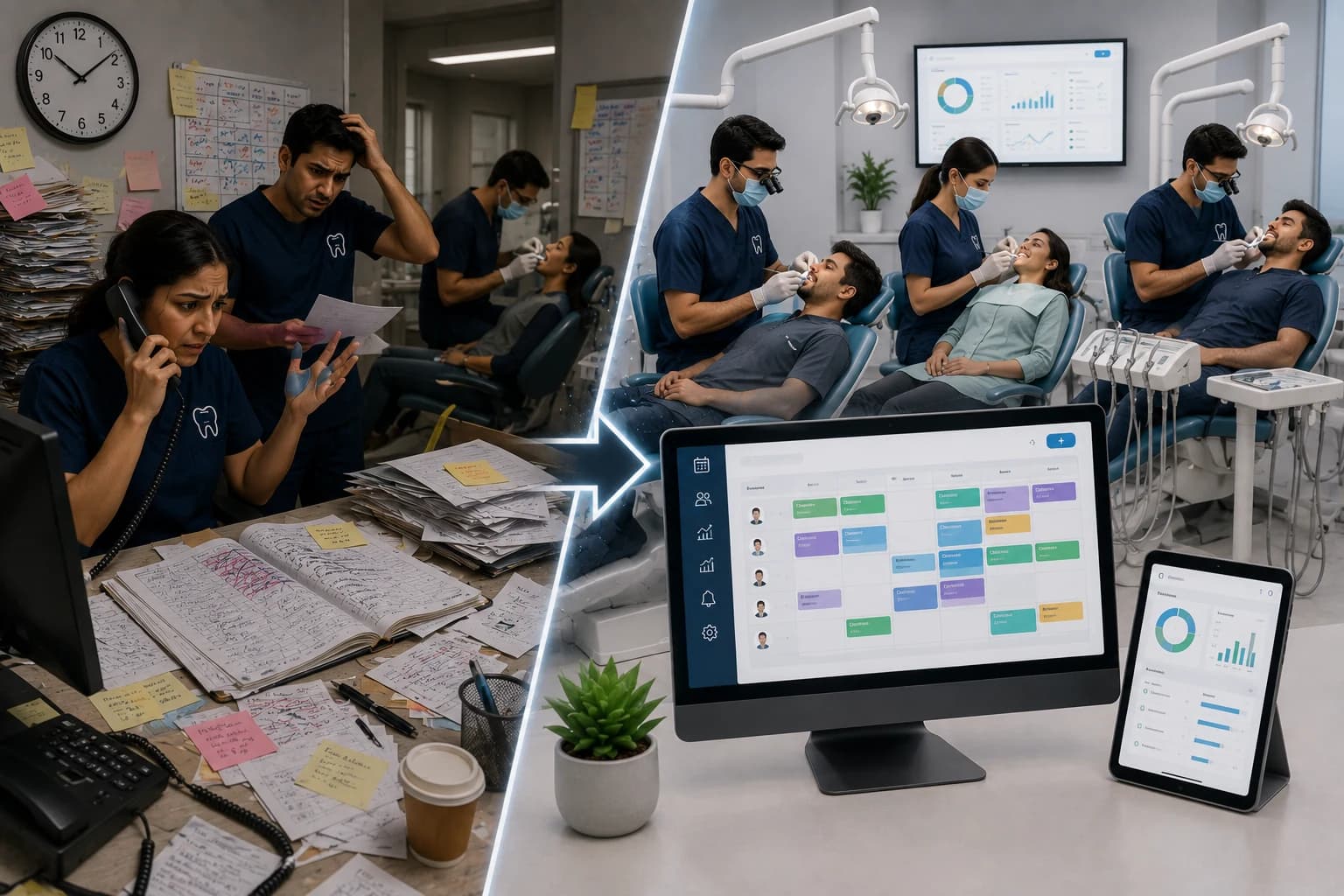
Monday 9:15 AM. Two dentists are ready. Three patients are waiting. Chair 2 is empty because the schedule said Dr. Khan was in Chair 3 — but he moved yesterday. The receptionist is calling patients while the assistant walks between rooms looking for a free light.
That is not a "busy clinic." That is a scheduling system failure — and it is expensive.
Industry scheduling analyses estimate open chair time costs the average dental practice about $200,000 per year in lost production opportunity (Resonate scheduling statistics). Most offices run 65–75% chair utilization; elite operators exceed 85% using disciplined templates, reminders, and real-time dashboards.
If you run 3 dentists and 4 chairs — a common growth layout in Lahore, Karachi, and Islamabad — this guide gives you the numbers, chair map, and weekly playbook to stop chaos without hiring another receptionist.
The Real Math: 3 Dentists, 4 Chairs, One Schedule
Chair utilization formula
Chair utilization % = (Total patient treatment time ÷ Total available chair time) × 100
Example — 4 chairs, 10 hours clinic day, 250 working days:
- Available chair-minutes: 4 × 10 × 60 × 250 = 6,000,000 minutes/year
- At 70% utilization, you lose 30% = 1,800,000 minutes of potential care
- If average production is $3.50/minute (~$210/hour), that idle share is $6.3M minutes × $3.50 — directionally why under-scheduling seven-figure annual leakage is discussed in industry reports
You do not need four dentists to fill four chairs. You need rules so chairs never sit empty while patients wait.
Planet DDS 2026: Efficiency beats size
The 2026 Dental Industry Deep Dive (Planet DDS) analyzed $7.79B gross production across 3,294 same-store practices and 497 DSOs — one of the largest published group-practice datasets.
Key finding for multi-chair owners: Scale alone does not drive growth. Nearly 1,050 practices averaged 44 chairs but only about $56,000 annual revenue per chair — massive underutilization. The report stresses revenue per chair and case completion (industry average 47% case completion; wide gaps between acceptance and completion) over buying more ops (Planet DDS Deep Dive, 2026).
Translation for your 4-chair clinic: The fourth chair is profitable only if scheduled with intent, not hope.
7 Scheduling Problems That Create Chaos (And Fixes)
1. No chair assigned to the appointment
Symptom: Dentists "grab" any room; instruments trail; turnover overlaps.
Fix: Every appointment stores dentistId + chairId + start/end + procedure type. Denzif and similar systems should block double-booking the same chair. Display a chair board at reception: four columns, time down the left.
2. Ignoring buffer and slot duration
Symptom: 30-minute slots for 45-minute crown preps → cascading delays.
Fix: Set slot duration and buffer time in clinic settings (e.g., 30 + 10 minutes). All slot generators — admin UI, public booking, reschedule — must use slotDuration + buffer consistently.
3. No-shows hollow the middle of the day
Average no-show rates: 15–20%; top 10% of practices run near 1% (Clerri scheduling benchmarks).
Fix: Three-touch WhatsApp reminders (book, 24–48h, day-of). Maintain a waitlist; fill cancellations within 2 hours when possible. Practices using automated reminders report 22.95% fewer no-shows in a 1.6M appointment cohort analysis — see the full no-show cost breakdown.
4. Hygiene and doctor volumes fight for the same chairs
Benchmark: ~2 hygienists per full-time dentist for preventive demand (Overjet practice capacity guide).
Fix with 4 chairs:
- Chairs 1–2: Doctor primary (assign per dentist)
- Chair 3: Hygiene / overflow
- Chair 4: Long procedures, emergency, or second doctor peak
5. Split shifts not reflected in software
Many Pakistani clinics close 1–4 PM and reopen evening.
Fix: Configure multiple sessions per day in business hours so online booking and internal slots never offer 2 PM Friday when you are closed.
6. Case acceptance without completion discipline
Planet DDS notes practices with 50+ point gaps between acceptance and completion may show 77% acceptance but only ~20% completion — scheduling never closes the loop.
Fix: Treatment coordinator books next visit before checkout; weekly report of accepted-but-unscheduled plans.
7. No daily huddle
Fix — 15-minute huddle (8:45 AM):
- Production target per dentist
- High no-show risk appointments (flag new patients)
- Gaps >60 minutes — assign waitlist
- Lab cases arriving today
The 3-Dentist / 4-Chair Template (Copy This)
| Chair | Primary use | Sample day block |
|---|---|---|
| Chair 1 | Dr. A — restorative | New patient 9:00, RCT 11:00, composite 3:00 |
| Chair 2 | Dr. B — restorative | Hygiene handoff 9:30, crown prep 10:30, review 4:00 |
| Chair 3 | Dr. C + hygiene | Hygiene 9–12, Dr. C exams 2–5 |
| Chair 4 | Float / emergency | Emergency 11:30, long surgical 1:00, fill-in from waitlist |
Stagger starts: Dr. A 9:00, Dr. B 9:20, Dr. C 9:40 — reduces reception pile-ups.
New patients: Book 90 minutes in float chair with assistant setup checklist.
KPI Dashboard: What to Track Weekly
| KPI | Target | Why it matters |
|---|---|---|
| Chair utilization | >80% | Core efficiency metric |
| No-show rate | <10% (stretch <5%) | Direct empty-chair driver |
| Same-day fill rate | >50% of cancellations | Recovers $200–$375/slot |
| Production per chair day | Track vs $3,815 dentist/day benchmark (group practice avg, Clerri) | Normalizes dentist mix |
| Active patients / dentist | 1,500–1,800 | Capacity planning |
| Unscheduled accepted treatment | ↓ weekly | Closes Planet DDS "completion gap" |
Pakistan-Specific Operations
- WhatsApp-first confirmations — patients respond on mobile, not landline
- Cash + digital mix — record payments at checkout so billing does not delay the next chair turnover
- Power/internet blips — print one-page chair schedule each morning as fallback; use software that syncs after reconnect
- Ramadan / holiday hours — update session templates once, not per appointment
14-Day Implementation Plan
Days 1–3: Enforce dentist + chair on every booking; train reception on chair board.
Days 4–7: Turn on automated reminders + waitlist; measure no-show rate.
Days 8–10: Block scheduling for crown/endo/new patient; set buffers.
Days 11–14: First weekly KPI review; reassign float chair rules if Chair 4 idle >25%.
The Bottom Line
3 dentists and 4 chairs should feel like capacity, not confusion. The data is clear: ~$200,000 average annual cost of scheduling inefficiency, 85%+ utilization for top performers, and 2026 DSO evidence that revenue per chair matters more than counting chairs.
Fix assignment, buffers, reminders, and completion discipline — your fourth chair becomes a profit center instead of an expensive closet.
About Denzif
Denzif is cloud dental practice management for established small-to-mid clinics in Pakistan — patients, appointments, treatments, billing, inventory, WhatsApp reminders, and optional AI on Standard. Get custom PKR pricing or request a private walkthrough.
Frequently Asked Questions
Most practices operate at 65–75% utilization without advanced scheduling. High-performing offices exceed 85% by measuring (patient treatment time ÷ available chair time) × 100, using block scheduling, waitlists, and automated reminders. Industry analyses attribute roughly $200,000 in annual lost opportunity to open chair time at typical practices.
Ready to put this into practice?
Custom PKR pricing for established clinics. Private walkthrough after we confirm fit. Setup in about 15 minutes.