WhatsApp Reminders for Dental Clinics: Cut No-Shows 40–60% (Scripts Included)
Copy-paste WhatsApp reminder scripts for dental clinics. 98% open rates, a 3-touch sequence, and ROI math — cut no-shows 40–60% within 60 days.
Quick answer
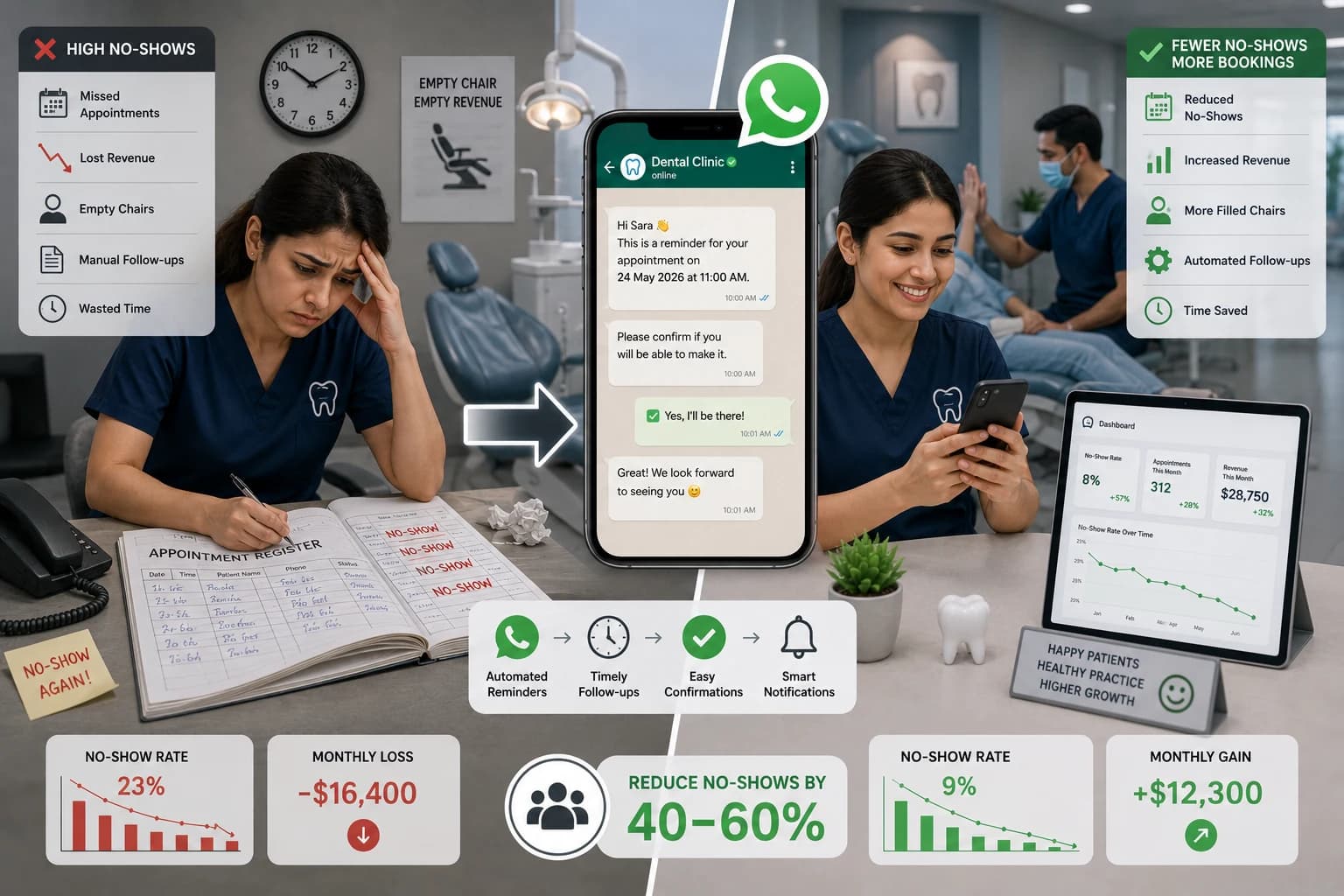
WhatsApp automation cuts dental no-shows 40–60% by sending timed confirmations patients actually read — 98% open rates vs ~20% for email. A 3-touch sequence (book, 48h, 24h) with confirm/cancel replies fills gaps faster than phone tag alone.
Your receptionist called 40 patients yesterday. Twelve did not answer. Four said they would confirm later — and never did. Meanwhile, three chairs sat empty this morning while the schedule on paper still showed them full.
That is not a staffing problem. It is a channel problem. In Pakistan, WhatsApp is where patients actually read messages — not missed calls, not email, and often not SMS to a number they do not recognize.
Clinics that switch from manual phone reminders to automated WhatsApp appointment flows routinely cut no-shows by 40–60% (and up to 68% in documented healthcare cohorts). On a practice losing $8,750–$20,000 per month to empty chairs — see the full breakdown in How Much Money Are You Losing to No-Shows? — that is $42,000–$120,000+ recovered annually without adding a single operatory.
This guide explains the numbers, the exact automation sequence, Pakistan-specific setup, and how to go live in one week. Reminders work best inside integrated dental software tied to your live schedule.
The Real Cost of No-Shows (Why WhatsApp Matters Now)
The average dental no-show rate sits at 15–20% globally; many Pakistani urban clinics run 25–35% when reminders depend on phone tag.
Each missed appointment costs $200–$375 (roughly PKR 55,000–105,000) in lost production.
Formula: daily appointments × no-show rate × average appointment value × 250 working days = annual loss.
Example: 35 appointments/day, 28% no-shows, $250 average → ~10 empty slots daily → ~$625,000 PKR equivalent lost per year on one chair schedule.
36% of no-shows are forgetfulness — patients who intended to come but never saw a reminder on the channel they use. WhatsApp fixes that layer first.
What the Data Says About WhatsApp Reminders
Large-scale dental automation
A study of 1,604,184 appointments across 64 dental practices (Sesame Communications, five-year panel) found automated reminders reduced no-shows by 22.95%, with roughly $31,457 incremental production per practice from better schedule compliance over 36 months.
WhatsApp vs SMS in dental networks
Spanish dental network Vitaldent (390 clinics) replaced SMS with WhatsApp utility messages for scheduling (Aug 2024–Feb 2025) and reported:
- 96% customer response rate
- 90% appointment confirmation rate
- 30% higher response than SMS
- 70% less staff workload on confirmations
South Asia healthcare cohort
Twelve Indore-area providers tracked 8,400+ appointments over six months (2024): average no-show rate fell from 31% to 10% (68% reduction) after WhatsApp Business API reminders — dental clinics in the cohort started around 28–35% no-shows.
Engagement benchmarks (2026 channel comparisons)
- WhatsApp: ~98% open rate, 40–60% reply within an hour
- SMS: ~95% open but only ~8% reply
- Email: ~20% open for appointment content
A patient who taps "Confirm" in WhatsApp makes a micro-commitment — practices see 15–25% additional no-show reduction versus one-way blasts.
Bottom line: WhatsApp does not magically fix anxiety or transport barriers — but it eliminates the largest bucket (forgetfulness + friction) and frees your front desk from 10–20 hours/week of reminder calls.
Why Manual Phone Reminders Fail in 2026
| Manual calling | WhatsApp automation |
|---|---|
| 2–4 minutes per patient | Seconds per patient (batch send) |
| Only during desk hours | 24/7 delivery and replies |
| No audit trail | Logged confirm / reschedule in CRM |
| Inconsistent — busy days skip calls | Every appointment gets the same 3-touch sequence |
| Patients avoid unknown numbers | Patients recognize clinic WhatsApp name |
When your receptionist is checking in three patients and the phone rings, reminder calls are the task that gets dropped. Automation is not impersonal — it is reliable.
The 3-Touch WhatsApp Sequence That Works
Touch 1 — Booking confirmation (immediate)
Send within 5 minutes of booking (online form, widget, or front desk):
- Patient first name
- Date and time (PKT — always state timezone)
- Dentist name and clinic address / map link
- Confirm and Reschedule actions (template buttons or quick replies)
Goal: Lock the appointment in the patient's mind while intent is high.
Touch 2 — 24 to 48 hours before
- Friendly reminder + appointment summary
- Ask for confirmation again
- Offer reschedule link (reduces no-shows more than harsh policies)
Goal: Catch plan changes early so you can fill the slot from waitlist.
Touch 3 — Day-of (2–3 hours before)
- Short message: "We are ready for you at {time}"
- Parking / gate instructions for multi-story clinics
- Optional: prep note for surgical cases
Goal: Last nudge for forgetful patients; reduces same-day no-shows by 20–30% in high-performing offices.
Optional Touch 4 — Post-visit (retention)
Thank-you + hygiene recall date. Practices with strong recall see 25–40% lower no-show rates on return visits.
WhatsApp Automation Features Worth Implementing
Two-way confirm and reschedule
Let patients confirm or request a new time inside WhatsApp. Your practice software should write that status back to the appointment — no copy-paste for staff.
Waitlist backfill when someone cancels
When a reminder triggers a cancellation 48 hours out, automatically message the waitlist: "A slot opened tomorrow at 11:00 — reply YES to book." Top clinics fill 80–90% of short-notice cancellations this way.
Template messages (Meta-approved)
Use utility templates for reminders — not promotional spam. Templates survive scale and avoid blocks. Personalize with variables: `{{1}}` name, `{{2}}` date, `{{3}}` time.
Credit and delivery tracking
Track WhatsApp credits per clinic, delivery status, and invalid numbers. Update patient records when a number fails — stop wasting credits on dead lines.
Integration with online booking
Patients who book via your public appointment form or website widget should enter WhatsApp opt-in once and enter the same automation queue as phone bookings — one pipeline, zero manual export.
Pakistan-Specific Playbook
1. Default channel: Ask "WhatsApp number?" on every new patient form — store as `923XXXXXXXXX` (12-digit format).
2. Language: Offer Roman Urdu + English templates; match the language used at booking.
3. Payments context: Pair reminder with "bring estimate deposit" only when policy is consistent — avoids surprise friction.
4. Friday / Sunday hours: Map reminders to split business hours (morning + evening sessions) so patients do not arrive during lunch closure.
5. Staff training: Receptionist handles exceptions only — automation owns the 80% routine confirms.
Urban practices report 12+ hours/week saved on reminder calls after month one — redeploy that time to treatment coordination and collections.
ROI: What 40–60% Fewer No-Shows Looks Like in Money
Assume:
- 180 appointments/month
- 30% no-show rate (54 misses)
- $250 average value
Monthly loss: 54 × $250 = $13,500
Reduce no-shows by 50% → recover 27 appointments × $250 = $6,750/month → $81,000/year.
Messaging + software: often under $3,000/year → 27× gross return before waitlist fills and retention gains.
Even a 40% improvement on a smaller $1M practice adds $30,000–$50,000 in collections — far above subscription cost.
Week-by-Week Rollout Plan
Week 1 — Measure and opt-in
- Calculate baseline no-show rate (last 30 days)
- Add WhatsApp opt-in checkbox to booking form and intake
- Audit patient numbers — fix invalid `923` formats
Week 2 — Templates and Touch 1–2
- Register WhatsApp Business (app or API via vendor)
- Submit utility templates for booking confirm + 24h reminder
- Connect templates to your practice management scheduler
Week 3 — Touch 3 + waitlist
- Enable day-of reminders
- Build waitlist segment (hygiene vs doctor, AM vs PM preference)
- Train front desk: only escalate non-responders after 24h
Week 4 — Optimize
- A/B test Urdu vs English for confirmation rate
- Track confirm %, no-show %, credits used
- Target ≤12% no-show rate by day 60; ≤8% by day 90
Common Mistakes (And Fixes)
Blasting promotional content on the reminder number — use a dedicated utility line; keep marketing separate.
No opt-in record — Meta can restrict the number; you lose deliverability.
One reminder only — single messages help, but three-touch protocols win in every large dataset.
Ignoring failed deliveries — mark `whatsappStatus` invalid and collect a corrected number at next visit.
No reschedule path — patients who cannot easily move the appointment simply no-show.
How This Connects to Your Broader Stack
WhatsApp automation works best when it is not a standalone bot:
- Scheduling enforces slot duration + buffer so reminders match real chair time
- Patient records store consent, language, and WhatsApp validity
- Billing follows confirmed visits — fewer ghost appointments on the ledger
- Form submissions from your public booking page feed the same reminder queue as manual bookings
That integration is what separates a chat tool from a revenue system.
The Bottom Line
No-shows are mostly a communication failure, not a patient morality problem. Pakistani patients already live on WhatsApp — your clinic should meet them there with automated, two-way, three-touch reminders.
Expect 40–60% reduction in missed appointments within 60–90 days when you combine WhatsApp automation with waitlist backfill and clear reschedule links. The math is simple: every recovered chair hour is $200–$375 back in your pocket.
Start this week: measure your rate, collect opt-ins, and turn on booking confirmations. Your front desk will feel the difference before month-end.
About Denzif
Denzif is cloud dental practice management for established small-to-mid clinics in Pakistan — patients, appointments, treatments, billing, inventory, WhatsApp reminders, and optional AI on Standard. Get custom PKR pricing or request a private walkthrough.
Frequently Asked Questions
Multi-practice studies show 23–68% reductions depending on baseline and protocol. A Sesame Communications analysis of 1.6M appointments found 22.95% fewer no-shows after automation. WhatsApp-first clinics in South Asia often move from 28–35% no-show rates toward 10–15% within 60–90 days.
Ready to put this into practice?
Custom PKR pricing for established clinics. Private walkthrough after we confirm fit. Setup in about 15 minutes.