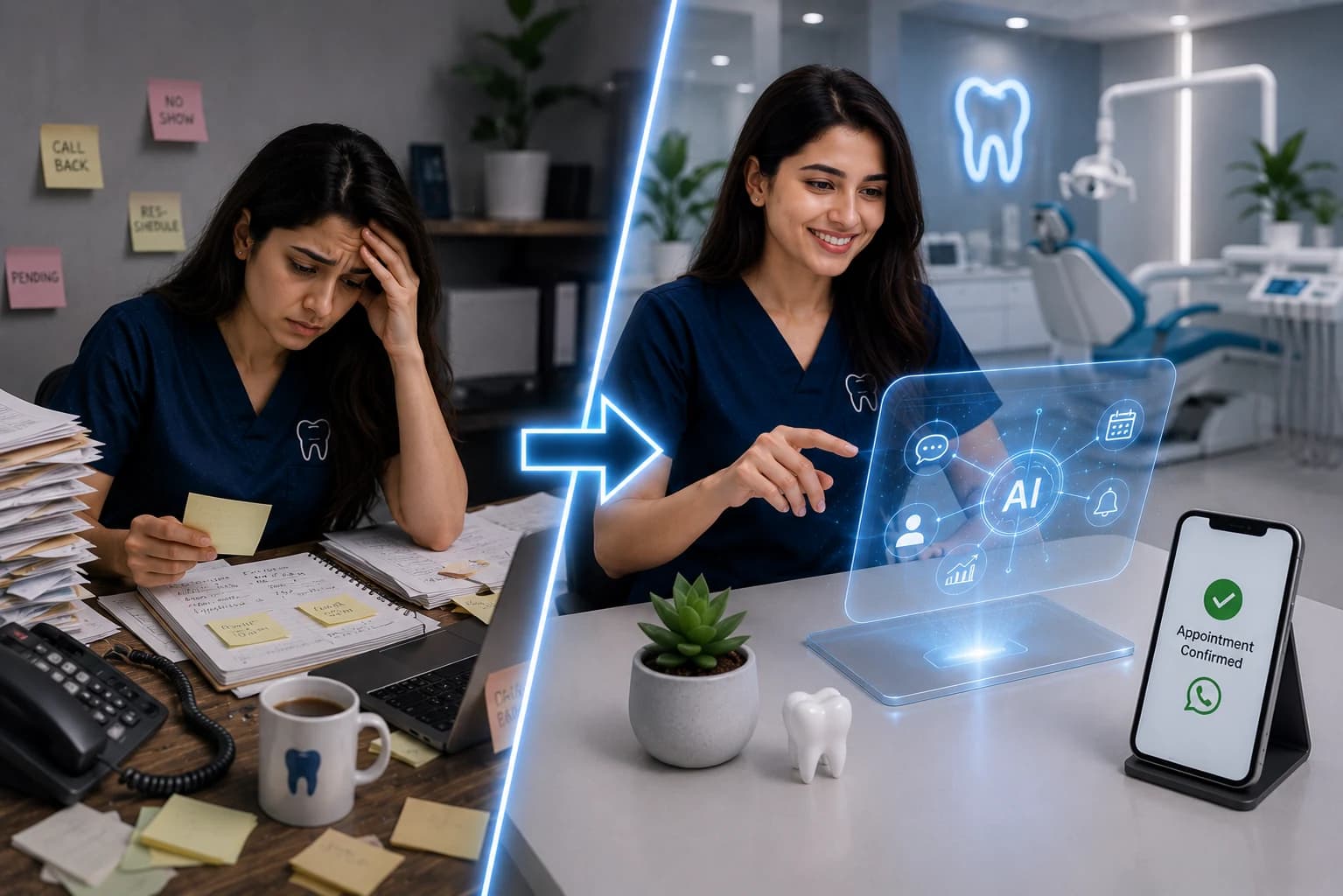
The Future of Dental Clinics: AI + Automation (What Changes by 2030)
32% of dentists already use AI tools. From recall agents to diagnostic support, here is what AI and automation change in dental clinics between now and 2030.
Quick answer
AI already runs recall, follow-up, and payment reminder agents in dental clinics, plus voice-to-text notes and AI consent forms. 32% of dentists use at least one AI tool in 2026, and dozens of dental AI devices hold FDA clearance. By 2030, expect diagnostic support, predictive scheduling, and automated documentation as standard — while diagnosis sign-off and patient care stay human.
The question is no longer whether AI enters dentistry — 32% of dentists already use at least one AI tool, and another 38% are evaluating one (2026 survey of 300 dental professionals). The real question is which jobs AI takes over by 2030, and which stay human. Clinics across Pakistan are already seeing real AI use cases in dentistry, mostly in places patients never see: the recall list, the follow-up queue, and the consultation note.
Here is an honest map of what AI does today, what changes by 2030, and what will not change at all.
Key takeaways
- AI in 2026 is mostly administrative: recall agents, follow-up automation, payment reminders, voice-to-text notes, and AI-drafted consent forms
- 32% of dentists use AI tools today; radiograph analysis dominates clinical use at 82% of adopters
- Regulators cleared a wave of dental AI: one analysis counted 44 FDA-cleared dental AI devices between 2021 and 2025 — 18 in 2025 alone
- By 2030, expect diagnostic support and predictive scheduling as standard software features, not premium add-ons
- Diagnosis sign-off, procedures, and patient relationships stay human — AI compresses the work around them
- Clinics that digitize records and workflows now will adopt 2030 AI cheaply; paper clinics will pay twice
What AI Already Does in Clinics Today
Forget the robot-dentist headlines. The AI quietly producing returns in 2026 works on communication and documentation — the layer where clinics lose hours and revenue daily.
Communication agents
An AI agent is software that owns one defined job end to end. In Denzif AI, that means a Recall Agent that finds overdue patients and messages them automatically, a Follow-up Agent that checks in after treatment, a Payment Reminder Agent that chases pending balances politely, and an Urgent Care Agent that triages urgent patient messages. Each agent works from live clinic data through an auto-syncing knowledge base — not a generic chatbot script. You can see how the full multi-agent system works on the Denzif AI dental software page.
Documentation automation
Voice-to-text turns a spoken consultation summary into a structured note before the patient reaches reception. AI consent form generation drafts procedure-specific consent documents in seconds instead of photocopying a generic template. Both remove chairside admin without touching clinical decisions.
Clinical imaging support
On the clinical side, radiograph analysis is the breakout category. A BMC Oral Health review found that 48% of FDA-cleared dental AI/ML devices are indicated for oral radiology (FDA-cleared dental devices study). These tools flag caries, measure bone loss, and annotate images in real time — with clinical studies reporting 85–98% sensitivity for common findings. The dentist still confirms every finding; the AI ensures fewer get missed.
The Regulatory Signal: AI Is Past the Experiment Phase
Clearance data tells the adoption story better than marketing does. An analysis of FDA 510(k) clearances counted 44 AI-powered dental software devices cleared between 2021 and 2025 — with 18 clearances in 2025 alone, more than the previous two years combined (dental AI 510(k) analysis).
About 77% of those devices are diagnostic, confirming where the technology is mature: detection and analysis, not autonomous treatment. When regulators clear devices at this pace, the technology has moved from research project to standard of care trajectory.
Today vs 2030: What Actually Changes
| Clinic job | Today (2026) | By 2030 |
|---|---|---|
| Patient recall | AI agents message overdue patients via WhatsApp | Fully autonomous recall with smart timing per patient |
| Appointment scheduling | Online booking + manual slot planning | Predictive scheduling that forecasts no-shows and overruns |
| Consultation notes | Voice-to-text drafts, dentist edits | Ambient documentation — notes written as you speak |
| Consent forms | AI drafts from templates | Auto-generated, procedure- and patient-specific |
| Radiograph reading | AI flags findings, dentist confirms | AI pre-screening standard on every image |
| Treatment planning | Manual, experience-based | AI-suggested options with outcome data, dentist decides |
| Billing follow-up | Payment reminder agents | Automated payment plans tuned to patient history |
| Diagnosis sign-off | Human | Human |
| Procedures and surgery | Human | Human |
Two patterns stand out. First, everything administrative converges toward full automation. Second, the clinical column never flips — it gains decision support, not decision makers.
Predictive scheduling deserves a closer look
Scheduling is where 2030 gets interesting for clinic owners. Appointment history contains predictable signals: which patients confirm but skip, which procedures run long, which weekday afternoons collapse. Software that learns these patterns can overbook intelligently, place buffers where overruns actually happen, and aim reminders at the patients most likely to vanish. None of this requires new hardware — just clean digital appointment data, which is exactly what paper-register clinics will not have.
What Stays Human (and Why That Is Good News)
The honest version of the 2030 story: AI compresses the work around dentistry, not dentistry itself.
- Diagnosis and treatment decisions — regulators classify dental AI as assistive; a licensed dentist signs off, full stop
- Procedures — extraction, restoration, and surgery remain hands-on skills
- Trust and rapport — anxious patients are calmed by people, not push notifications
- Judgment calls — when to wait, when to refer, when a patient's finances should shape the treatment plan
For clinic owners this is the best possible outcome. The work AI removes — chasing overdue patients, retyping notes, sending reminder texts — is the work nobody opened a clinic to do.
How to Prepare Your Clinic Now
The clinics that benefit from 2030 AI are the ones with clean digital foundations in 2026. AI agents cannot recall patients whose numbers live in a register book, and predictive scheduling cannot learn from appointments that were never logged.
1. Digitize records and appointments first — the full path is covered in our guide to going fully digital
2. Automate communication second — reminders, recall, payment follow-ups; measurable ROI within a month
3. Add documentation AI third — voice notes and consent forms to reclaim chairside time
4. Protect the data layer — automated daily backups become critical once AI systems depend on your clinic data
5. Evaluate diagnostic AI last — useful, but only after the operational layer pays for itself
Pakistan Clinic Context
Pakistan's clinics may leapfrog Western adoption patterns for one structural reason: WhatsApp. Western dental AI grew up around email and patient portals that patients ignore; Pakistani patients live on WhatsApp, where open rates make automated recall and follow-up dramatically more effective per message. Combine that with lean front desks — often one receptionist juggling walk-ins, calls, and billing — and communication automation solves a staffing problem, not just a convenience problem. Cloud-based AI tools also sidestep load-shedding, since nothing depends on a server in the back room.
Denzif AI was built for exactly this context: a multi-agent system — Recall, Follow-up, Payment Reminder, and Urgent Care agents — plus voice-to-text consultation notes, AI consent forms, an AI website widget, and a clinic admin chat assistant, all running on top of full practice management and messaging patients through WhatsApp.
The Bottom Line
The future of dental clinics is not a robot in the operatory — it is an empty admin queue. 32% of dentists already use AI, regulators cleared a record 18 dental AI devices in 2025, and by 2030 recall, scheduling, documentation, and image pre-screening will be automated defaults. Diagnosis and care stay human. The clinics that win will be the ones whose data was digital before the tools arrived.
About Denzif
Denzif is cloud dental practice management for established small-to-mid clinics in Pakistan — patients, appointments, treatments, billing, inventory, WhatsApp reminders, and optional AI on Standard. Get custom PKR pricing or request a private walkthrough.
Frequently Asked Questions
In 2026, AI handles communication and documentation work: recall agents that bring overdue patients back, post-treatment follow-up messages, payment reminders, voice-to-text consultation notes, and AI-drafted consent forms. On the clinical side, FDA-cleared imaging AI flags caries and bone loss on radiographs in thousands of practices.
Ready to put this into practice?
Custom PKR pricing for established clinics. Private walkthrough after we confirm fit. Setup in about 15 minutes.