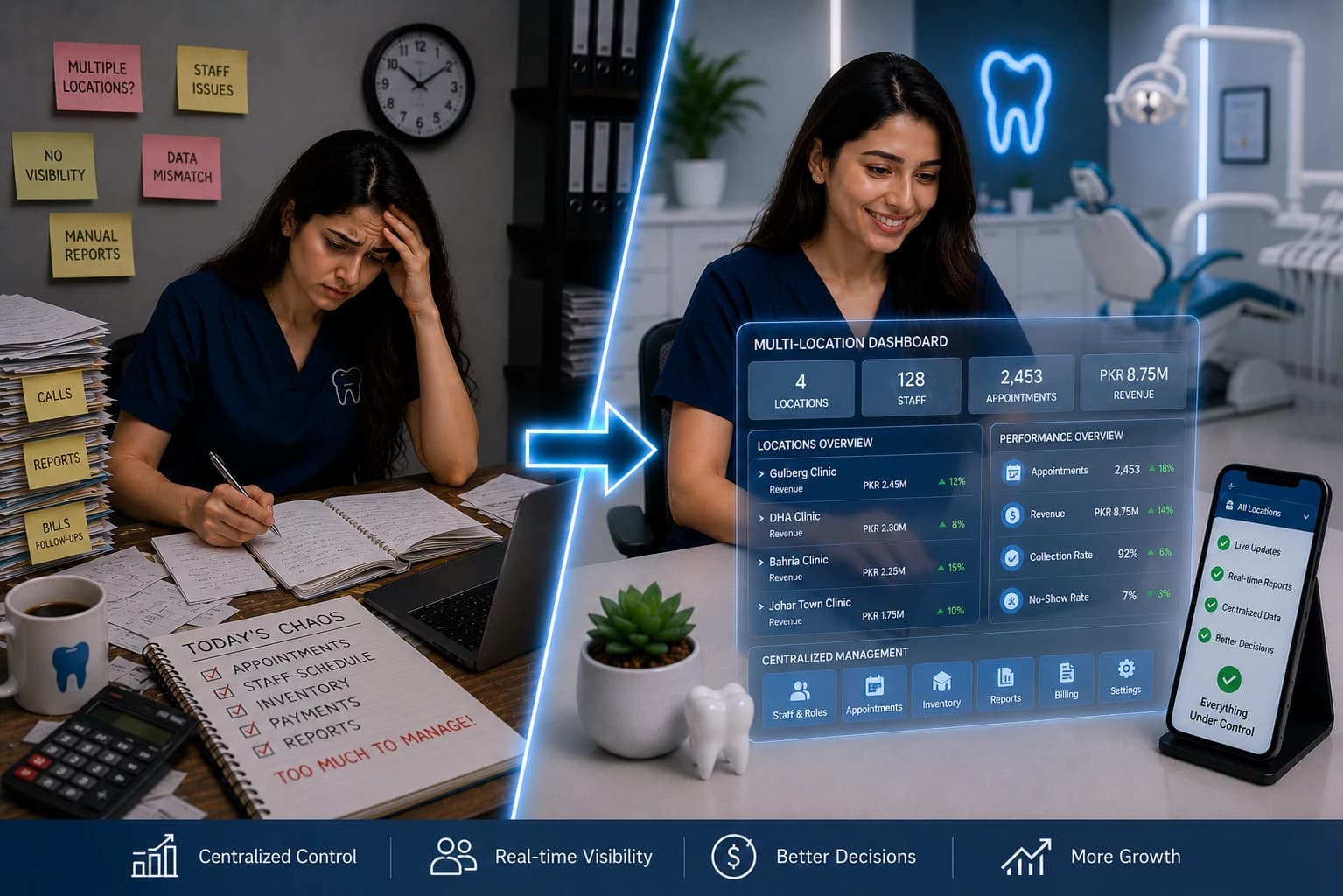
Managing Multiple Dental Clinic Locations: The Complete Guide (2026)
Two branches feel manageable. Five feel chaotic. Learn why multi-location dental groups leak revenue, which systems to standardize first, and how Pakistan owners scale without drowning in spreadsheets.
Quick answer
Managing multiple dental clinic locations fails when each site runs different software, fee schedules, and staff SOPs — 92% of practices juggle four or more systems daily. Groups that standardize scheduling, billing, and KPIs before opening the next branch recover 8–12% of revenue otherwise lost to fragmentation.
Opening a second dental clinic feels like victory. By the fourth or fifth, the same owner who once knew every patient by name is drowning in branch WhatsApp groups, conflicting fee lists, and month-end reports that never agree.
Multi-location management is not "one clinic, but bigger." It is a different operating model — and the seven major problems that stall single-site practices multiply when each branch solves them differently.
Key takeaways
- Fragmentation is the default — 92% of dental practices already run four or more systems daily; each new location adds another silo without deliberate standardization.
- Revenue leaks in the gaps — disconnected billing and reporting can cost groups 8–12% of annual production.
- Chair utilization beats branch count — groups that fill existing capacity grow faster than those that expand with empty schedules.
- Standardize the patient journey first — booking, reminders, charting, and billing handoffs before you standardize marketing or décor.
- Pakistan groups often run one system per branch — consistent SOPs and cloud access matter as much as a single enterprise dashboard early on.
- Software choice must match your scale — solo-location cloud tools excel per site; true multi-location rollups need either enterprise DSO platforms or disciplined per-branch tenants.
Why multiple locations break down (the real reasons)
Every branch invents its own workflow
Branch A confirms appointments on WhatsApp. Branch B still uses a paper diary. Branch C's receptionist edits fees in a personal spreadsheet. None of this is malicious — it is what happens when growth outpaces governance.
Mid-market dental groups describe a constant state of coordination: scheduling, records, follow-ups, and messaging scattered across tools added one location at a time. Without shared visibility, leadership stops trusting the numbers.
Data you cannot roll up is data you cannot fix
A practice manager overseeing ten clinics with legacy desktop software at each site may need ten separate logins and hours of spreadsheet work for a single "how did we do this month?" answer. By the time reports arrive, the fix window has passed.
Planet DDS industry research notes that fragmented technology stacks are a leadership problem: each disconnected system compounds labor, erodes data trust, and lets revenue leak because no one sees where it went.
Staffing pressure does not scale linearly
The American Dental Association reports that roughly 90% of practices still find hiring hygienists very or extremely challenging. Adding locations multiplies recruitment, training, and retention load. A group that cannot staff one clinic well will not staff three by copying the same ad three times.
The multi-location operating stack
Think in layers. You do not need every enterprise feature on day one — but you do need intentional choices at each layer.
| Layer | What to standardize | Why it matters |
|---|---|---|
| Patient access | Booking rules, reminder timing, cancellation policy | Same patient experience = fewer no-shows group-wide |
| Clinical ops | Charting format, treatment naming, consent flow | Providers can cover each other's chairs |
| Revenue | Fee schedule, invoice template, payment status labels | Comparable branch P&L |
| Inventory | Reorder levels, supplier list, stock categories | Transfer and bulk-buy leverage |
| People | Role titles, handoff checklists, escalation paths | Staff management stops being tribal knowledge |
| Leadership | Weekly KPI sheet, monthly owner review | Decisions before crises |
Scheduling: the hub everything else touches
If branches schedule differently, everything downstream wobbles — billing, lab cases, associate pay, and patient expectations. Groups that nail multi-dentist scheduling rules at one site can clone slot duration, buffer time, and working-day templates to new locations in an afternoon.
Peerlogic's 2026 operating standards research found that emerging mid-market groups feel complexity compound with every new location: more calls, more staff, more volume, more moving parts. Orchestration — standardized workflows plus consolidated visibility — beats adding another point solution per branch.
KPIs every multi-location owner should review weekly
Do not wait for the accountant. These six numbers, per branch and consolidated, tell you whether expansion is working:
1. Production per chair hour — compares efficiency, not just size.
2. Collection rate — billed work that never gets paid is a branch problem and a systems problem.
3. No-show and short-notice cancellation rate — use no-show cost math to rank branches.
4. New patients per week — marketing may differ by area; the trend should not be invisible.
5. Case acceptance or treatment plan follow-through — industry DSO benchmarks often sit near 34% closed treatment; groups above 40% pull ahead materially.
6. Staff cost as % of collections — flags overstaffing or underproduction before payroll shocks.
Put them on one page. Review every Monday. Branches that miss two weeks in a row get a visit, not another email.
The expansion decision: when to open branch N+1
Planet DDS 2026 outlook data emphasizes that scale alone does not drive growth — increasing chair count without utilization gains underperforms. Nearly 1,050 benchmarked practices averaged 44 chairs but only about $56K annual revenue per chair, highlighting underutilization as the largest addressable opportunity.
Ask before signing a new lease:
- Are current locations above 75–80% chair utilization during core hours?
- Can you name the lead dentist and office manager for the new site six months out?
- Will the new branch use the same PMS configuration, not "similar"?
- Do you have 90 days of working capital for ramp-up collections?
If two answers are no, fix the existing footprint first.
Technology choices at 2, 5, and 20 locations
Two to three branches (typical Pakistan group)
Many owners here run one cloud practice-management tenant per branch with copied settings: same appointment durations, WhatsApp reminder templates, billing categories, and staff training docs. You may not have a single cross-branch dashboard yet — but you avoid the chaos of one branch on paper and another on a 2012 desktop install.
Denzif is built for single-clinic tenants — each location gets its own account with PKT scheduling, WhatsApp reminders, billing, and inventory. A growing Pakistan group can standardize operations by mirroring configuration across branches while leadership maintains a simple rollup spreadsheet until scale warrants enterprise tooling. That is honest scope: not a replacement for DSO-grade multi-location analytics, but a clean per-site foundation.
Five to twenty branches (emerging DSO)
This is the hardest band. Mega-DSOs build custom stacks; solo practices survive on relationships. Mid-size groups need shared revenue-cycle workflows, centralized reporting, and IT consistency — research cites 8–12% annual revenue at risk from disconnected systems in this tier.
Prioritize: unified patient communication rules, standardized fee schedules, and a single source of truth for production and collections. Inventory mistakes that cost one branch PKR 50,000 repeat fivefold without group purchasing discipline.
Twenty-plus locations (enterprise)
You are buying integration projects, not apps. Data migration, training cohorts, and a network operations mindset (uptime, backups, access control) become line items. The ADA practice management resources remain useful for governance frameworks even as tooling grows more complex.
Standard operating procedures that actually stick
Documents no one reads are wallpaper. SOPs work when they are short, role-specific, and tied to software screens staff already use.
Minimum viable SOP set for a new branch:
- Opening checklist (cash float, chair prep, WhatsApp business hours)
- Booking and reschedule script (including fee disclosure for no-shows)
- New patient intake → chart → first billing event
- End-of-day reconciliation (appointments completed vs invoiced)
- Weekly inventory spot-check for high-turnover items
Train the branch manager to run reception onboarding in seven days using the parent clinic's materials — not a rewrite per site.
Pakistan context: chains, families, and load-shedding
Pakistan dental groups often grow through family expansion — a sibling opens in DHA, a cousin in Gulberg — rather than private-equity DSO rollups. That trust helps early hiring but hurts standardization: "we're family" becomes "we do it our way here."
Cloud access matters when load-shedding or ISP outages hit one area harder than another. Branches on local servers lose an afternoon; branches on cloud practice software with mobile data failover lose minutes. WhatsApp-native reminders also outperform email-first tools for patient confirmation in local markets.
Published PKR pricing per branch (rather than opaque per-seat quotes) keeps finance predictable as headcount grows.
Common mistakes when managing multiple dental clinics
| Mistake | What happens | Fix |
|---|---|---|
| Clone the building, not the playbook | Pretty new clinic, old chaos | Copy software config + SOPs before grand opening |
| Owner as only integrator | Bottleneck at 3+ sites | Hire or promote a regional manager with KPI authority |
| Different fee schedules per branch | Patients arbitrage; analytics lie | Master fee list with location-specific rent adjustments only |
| No shared reminder policy | One branch bleeds no-shows | Group-wide confirmation timing |
| Expand before collections discipline | More chairs, more udhaar | Fix billing follow-up at home base |
A 90-day standardization sprint (practical)
Days 1–30: Pick the best-performing branch as the template. Export fee list, appointment settings, reminder scripts, and role descriptions. Document the Monday KPI review.
Days 31–60: Align every other branch to the template. Run shadow audits: mystery patient calls, chart sampling, end-of-day billing match.
Days 61–90: Launch group purchasing for top 20 consumables. Schedule quarterly cross-branch training half-days. Only then revisit expansion plans.
The Bottom Line
Managing multiple dental clinic locations is an operations problem disguised as a real-estate strategy. Groups that standardize scheduling, billing, and KPIs before the next lease recover revenue otherwise lost in the 8–12% fragmentation band — while those that add chairs without utilization discipline stall.
Start with one branch done right, clone the system (not just the logo), and measure revenue per chair before you measure square footage.
About Denzif
Denzif is cloud dental practice management for established small-to-mid clinics in Pakistan — patients, appointments, treatments, billing, inventory, WhatsApp reminders, and optional AI on Standard. Get custom PKR pricing or request a private walkthrough.
Frequently Asked Questions
Each new branch adds staff, schedules, inventory, and billing workflows. Without shared systems, owners rely on WhatsApp updates and manual spreadsheets. Research shows 92% of dental practices operate across four or more disconnected tools daily — complexity multiplies with every location.
Ready to put this into practice?
Custom PKR pricing for established clinics. Private walkthrough after we confirm fit. Setup in about 15 minutes.