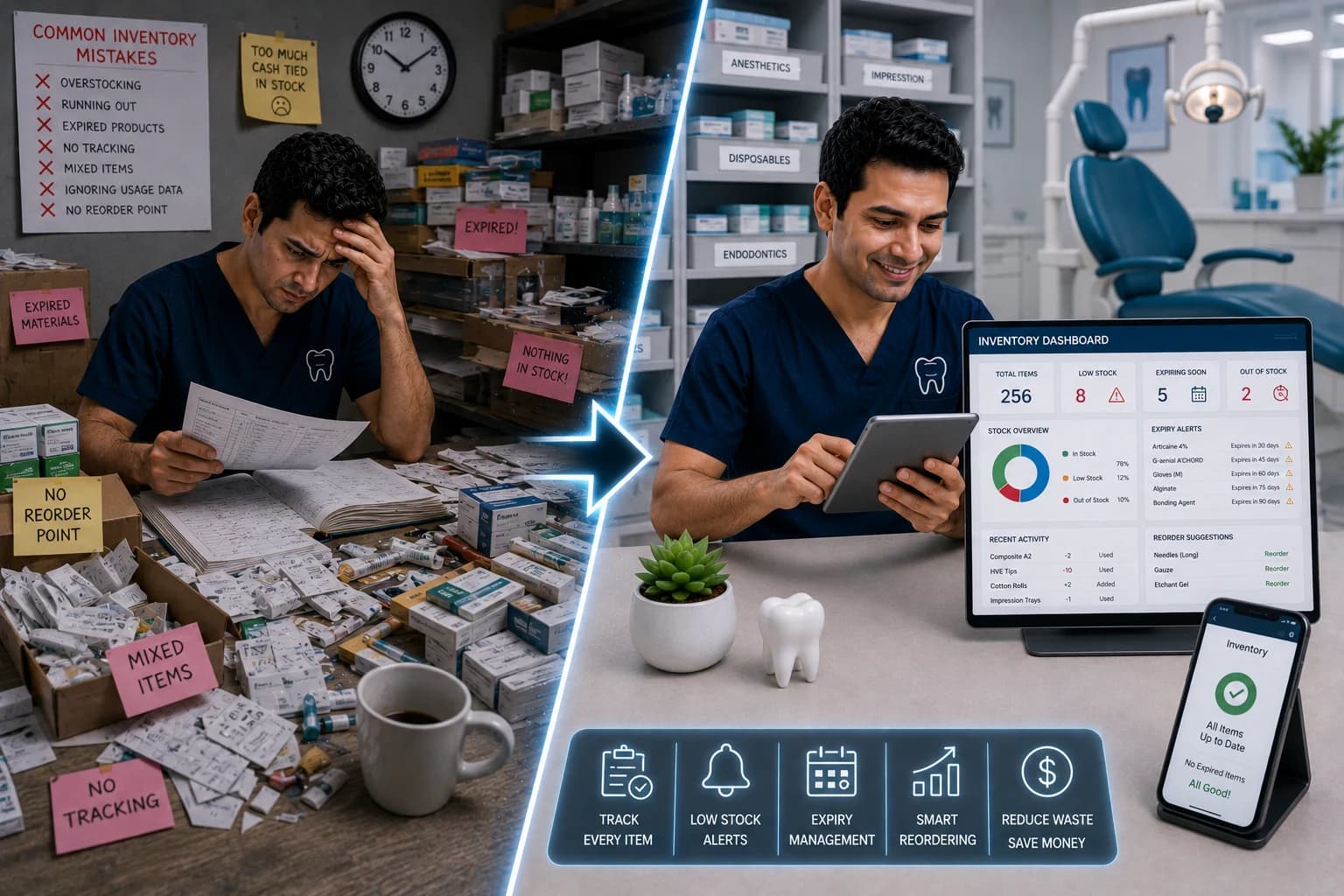
Inventory Management Mistakes Most Dentists Make
Poor dental inventory control costs $25K–$47K yearly in waste, rush orders, and stockouts. Learn the 7 mistakes, par-level math, and a 30-day fix plan for 2026.
Quick answer
Dental inventory mistakes — no par levels, manual counts, expired stock — waste $25K+ yearly. Inventory software with reorder alerts is included in Denzif Pro at no extra module fee.
A general dental clinic spending $72,000–$95,000 per year on supplies can easily lose $25,000–$47,000 to inventory mistakes it never puts on a P&L line — expired composites sitting in a drawer, duplicate glove orders from two staff members, and a 30–40% premium rush delivery because anesthetic ran out before the afternoon block.
That is not a supply-chain problem for hospitals. It is a daily habit problem in practices that still treat inventory as "whoever notices we're low should WhatsApp the dealer."
This guide covers the inventory management mistakes most dentists make, what they cost in 2026, and a practical fix path — with numbers, par-level math, and tables you can copy into your ops meeting. If pen-and-paper operations are still bleeding you elsewhere, inventory is often the next silent leak after no-shows.
The Real Cost of Dental Inventory Mistakes
Where the money goes
| Waste category | Typical annual impact (mid-size GP) | Primary cause |
|---|---|---|
| Expired / discarded materials | $4,000–$8,000 | Over-ordering, no FIFO |
| Emergency / rush orders | $8,000–$15,000 | Stockouts, no par alerts |
| Overstock carrying cost | $6,000–$12,000 | 60–90 days on hand vs. 30–45 |
| Duplicate / wrong SKU orders | $2,000–$5,000 | Multiple buyers, no master list |
| Staff time (counting, chasing) | $8,000–$15,000 | 2–6+ hours/week manual work |
| Production lost to stockouts | $10,000–$25,000+ | Mid-procedure delays, reschedules |
Industry analyses (Private Dental Alliance supply benchmarks; ADA practice management surveys) consistently show 15–25% of supply spend lost to preventable waste when inventory is informal. Top performers hold supplies near 5–6% of revenue; practices without controls often drift to 7–10%+ (DSO CFO benchmarks).
The hidden multiplier: chair time
A 45-minute delay from a stockout on a $350 restorative slot does not just cost the composite you lacked — it compresses the afternoon, pushes hygiene handoffs, and trains staff to "pad" orders next month. Multi-chair clinics feel this cascade faster than solo practices.
Mistake #1: No Single Source of Truth for SKUs
What it looks like
- Gloves ordered from three vendors at three prices
- "We always keep extra" impression material in the lab and operatory
- New assistant buys a brand the doctor does not use
The fix
Build one master SKU list (100–150 active items for most GPs, not every promotional sample):
| Field | Example |
|---|---|
| SKU name | Composite A2, 4g syringe |
| Primary vendor | Supplier X |
| Par level | 6 syringes |
| Reorder qty | 12 syringes |
| Storage location | Op 2 drawer |
| Last count date | 2026-06-01 |
Assign one ordering owner (office manager or lead assistant) per week. Everyone else requests through them.
Mistake #2: Par Levels Set Once and Never Updated
The math that actually works
Par level = (average daily use × lead time in days) + safety stock
Example: You use 2 anesthetic cartridges per day. Supplier lead time 5 days. You want 2 days safety buffer.
- (2 × 5) + 4 = 14 cartridges par
- Reorder when on-hand hits 14; typical order quantity = 2–4 weeks of use, not 6 months
Recalculate par levels every 90 days after seasonal changes (summer students, implant-heavy months, new associate).
| Item type | Suggested safety stock |
|---|---|
| Critical (can't start procedure) | 3–5 days usage |
| High turnover (gloves, gauze) | 7–10 days usage |
| Low turnover (specialty burs) | 1 reorder cycle only |
Mistake #3: Ignoring FIFO (First-In, First-Out)
Roughly 15% of dental practices report annual losses from expiring inventory (Gitnux dental supply chain data, 2026). FIFO is boring; it is also free money.
Operational rules
- New delivery goes behind older stock on the shelf
- Mark open boxes with open date (masking tape + marker works)
- Monthly "red tag" sweep: anything within 60 days of expiry gets used, returned if policy allows, or written off consciously — not discovered during a procedure
Mistake #4: Treating Emergency Orders as Normal
Emergency orders are a symptom, not a vendor relationship strategy. Benchmarking links rush purchasing to a large share of avoidable supply waste, often at 22–38% price premiums over standard delivery.
Stockout prevention checklist
- Par alert at reorder point, not at zero
- Critical SKU list (≤20 items) checked every Monday
- Backup vendor approved for top 5 SKUs only — not used weekly
- After any stockout: root-cause log (miscount? wrong par? theft? duplicate storage?)
Mistake #5: Buying on Habit Instead of Data
"I always order 10 boxes" survives three associate changes and doubles waste. Tie orders to consumption:
| Signal | Action |
|---|---|
| Usage up 20% for 60 days | Raise par; investigate case mix |
| Usage flat, stock growing | Cut reorder qty 25% |
| Promo "buy 10 get 2" | Only if on-hand < 30 days and SKU in top 50 by volume |
| New product trial | One operatory, 2-week pilot, then list decision |
Review supply % of revenue monthly. If revenue is flat but supply spend rises, the problem is usually process — not clinical need.
Mistake #6: No Cycle Counting — Only Panic Audits
Annual "count everything Saturday" events are expensive and inaccurate. Cycle counting spreads work and catches drift early:
| Week | Focus |
|---|---|
| 1 | Top 20 SKUs by spend |
| 2 | Anesthetic, composite, gloves, burs |
| 3 | Lab / impression materials |
| 4 | Low-turnover + expiry check |
Practices using regular cycle counts report ~15% fewer stockouts than those relying on visual guesses (industry inventory control surveys).
Mistake #7: Inventory Separate From the Rest of the Clinic System
When inventory lives in a notebook while appointments, billing, and patient records are digital, you get double entry and blind spots. Treatment volume rises; supply orders do not — until a stockout.
Integrated clinic software should offer:
- Item list with quantity and reorder level
- Low-stock visibility on one dashboard
- History of who adjusted counts and when
- Optional link to AI or ops summaries ("what's low this week?")
That is how you stop inventory from being a side project and make it part of weekly ops — same rhythm as confirming tomorrow's schedule.
Comparison: Manual vs. Disciplined Inventory
| Metric | Manual / memory-based | Disciplined + software |
|---|---|---|
| Supply waste (% of supply budget) | 15–25% | 5–10% |
| Stockouts per month | 8–14 (mid-size practice) | 0–2 |
| Staff time on inventory | 6–12 hrs/week | 1–3 hrs/week |
| Days of inventory on hand | 60–90 | 30–45 |
| Emergency order share of spend | High | Rare |
30-Day Inventory Recovery Plan
Week 1: Export last 6 months of supply invoices; list top 50 SKUs by spend; assign one ordering owner.
Week 2: Set par levels for top 20 SKUs; label storage locations; start FIFO on expiring items.
Week 3: Implement weekly cycle count rotation; log any stockout with cause.
Week 4: Review supply % of revenue; cut one redundant vendor or SKU; document reorder SOP for staff.
Target: 15–20% supply cost reduction in year one without compromising clinical standards — aligned with what well-run groups report after basic controls (supply chain ROI analyses).
Pakistan-Specific Inventory Notes
- Multi-supplier WhatsApp ordering creates duplicate deliveries — consolidate to one weekly order cadence per vendor
- Import lead times (implant kits, specialty materials) need longer par buffers — treat as critical SKU tier
- Load-shedding / storage: temperature-sensitive materials need a defined fridge + backup plan, not "whatever room is cool"
- Cash flow: carrying $15,000–$30,000 excess stock is common when par levels are ignored — cash tied in drawers cannot pay staff or marketing
- GST / invoicing: matching purchase invoices to received qty monthly catches vendor errors early
The Bottom Line
Most dentists do not have an inventory problem — they have a visibility and discipline problem. Expired composites, rush orders, and stockouts are not bad luck; they are predictable when one person, one SKU list, par levels, FIFO, and cycle counts are missing.
Closing even half of a $40,000 annual waste line returns $20,000 straight to margin — often more impactful than one extra hygiene day per week, with less marketing spend.
About Denzif
Denzif is cloud dental practice management for established small-to-mid clinics in Pakistan — patients, appointments, treatments, billing, inventory, WhatsApp reminders, and optional AI on Standard. Get custom PKR pricing or request a private walkthrough.
Frequently Asked Questions
Industry benchmarks put preventable losses at $25,000–$47,000 annually for a typical general practice — from expired materials, emergency rush orders, overstock carrying costs, and stockout-related production delays. Supply waste often runs 15–25% of the supply budget when systems are manual or ad hoc.
Ready to put this into practice?
Custom PKR pricing for established clinics. Private walkthrough after we confirm fit. Setup in about 15 minutes.