Best Appointment Scheduling Practices for Small Dental Clinics
Small clinics lose $80K–$150K yearly to bad scheduling. Learn slot templates, confirmation sequences, online booking, and utilization targets that top practices use in 2026.
Quick answer
Small dental clinics should use slot templates, WhatsApp confirmation sequences, and online booking to hit 85%+ chair utilization. Cloud dental software with per-dentist calendars prevents double-bookings without extra staff.
A two-chair clinic running 25 appointments a day with a 15% no-show rate loses roughly 3–4 slots daily — about $600–$1,200 in production that never happens. Over a year, that is $80,000–$150,000 in recoverable revenue from scheduling discipline alone, before you add a single new patient.
Small practices feel this pain more than large groups: one empty hour is 4–8% of the day's capacity, not a rounding error. The fix is not working harder at the front desk — it is how you structure slots, confirm visits, and fill gaps when life interrupts the plan.
This guide covers appointment scheduling practices for small dental clinics in 2026: templates, confirmations, online booking, block scheduling, and utilization targets — with numbers you can audit this week. If no-shows are already bleeding you, scheduling is the first lever; WhatsApp automation is the second.
Why Small Clinics Need Different Scheduling Rules
Volume vs. fragility
| Practice size | Daily appointments (typical) | Cost of one empty hour |
|---|---|---|
| Solo / 1 chair | 12–18 | 6–12% of daily production |
| Small (2 chairs) | 22–35 | 4–8% of daily production |
| Multi-provider (4+ chairs) | 50+ | 2–3% of daily production |
A missed hour at a solo practice hurts proportionally more. That is why small clinics need tighter templates and faster gap recovery — not looser "we'll fit them in" booking.
What top 10% practices do differently
Industry benchmarking (Henry Schein One Catalyst Index, 2026) shows top performers prioritize schedule reliability over raw volume:
| Metric | Industry average | Top 10% |
|---|---|---|
| New-patient lead time | 25 days | 4.5 days |
| No-show rate | ~4% (best-in-class cohort) | Under 1% |
| Patient retention | 70% | 94% |
Small clinics cannot copy DSO complexity — but they can copy confirmation routines, shorter new-patient lead times, and hygiene rebooking before checkout.
Build Your Slot Template (The Foundation)
Match duration to procedure — not the calendar default
| Appointment type | Recommended slot | Buffer after |
|---|---|---|
| Hygiene / prophy | 60 min | 5 min turnover |
| Exam + hygiene (new patient) | 90 min | 10 min |
| Restorative (1–2 surfaces) | 60 min | 5 min |
| Crown prep / RCT start | 90 min | 10 min |
| Emergency / limited exam | 30 min | Flexible |
Formula: `slot duration = clinical time + setup + documentation buffer`
If your software uses slot duration + buffer time (e.g., 30 min + 10 min buffer), every generated slot on the public form and admin calendar stays consistent — critical when patients book online.
Block scheduling for 1–2 dentists
Reserve predictable windows so high-value work does not get squeezed into hygiene gaps:
- Monday AM — new patients + exams
- Wednesday PM — restorative blocks
- Friday AM — hygiene-heavy (recall-friendly)
Block scheduling is how small practices protect production without adding chairs — the same principle multi-chair clinics use at larger scale.
The Three-Touch Confirmation Sequence
Forgetfulness drives roughly 36% of no-shows. A written, consistently applied confirmation path fixes most of that.
Recommended timeline
| Touch | When | Channel | Goal |
|---|---|---|---|
| 1 | 48–72 hours before | WhatsApp / SMS | Inform + offer reschedule link |
| 2 | 24 hours before | WhatsApp / SMS | Ask to confirm (reply YES) |
| 3 | 2 hours before | SMS | Day-of reminder |
Two-way confirmation (patient must reply) reduces no-shows 10–15% more than one-way blasts. In Pakistan, WhatsApp-first beats email — open rates on mobile messaging far exceed clinic inbox messages.
Targets for small general practices
| Metric | Acceptable | Strong |
|---|---|---|
| Overall no-show rate | Under 10% | Under 5% |
| New-patient no-show | Under 12% | Under 8% |
| Hygiene-only no-show | Under 8% | Under 6% |
| Late cancel + no-show combined | Under 15% | Under 10% |
Pair reminders with a waitlist: when a slot opens, message the next patient immediately. Practices report 40–60% of cancellations refilled when waitlist automation runs within minutes (industry practice management guides, 2026).
Online Booking Without Losing Control
What to expose publicly
- Dentist (or "any available")
- Procedure category (hygiene vs. consultation vs. emergency)
- Date + time from your slot engine — not free-text "whenever"
What to keep staff-only
- Long restorative blocks until case is accepted
- Same-day emergency overrides
- VIP / staff family slots
A branded **public appointment form on your clinic URL captures leads after hours and feeds pending submissions** your team approves — ideal when you are not ready for fully open self-scheduling.
Lead-time rule
Book new patients within 7 days when possible. Data across multiple practice studies shows no-show probability rises when the gap between booking and visit exceeds 25–30 days. For recall hygiene, 2–4 weeks is the sweet spot.
Same-Day Hygiene Rebooking (Highest ROI Habit)
Before the patient leaves the chair:
1. Offer the next cleaning date (6 months out).
2. Put it in the system — not a card in their wallet.
3. Trigger the same reminder sequence for that future visit.
Practices with same-day reappointment rates above 70% retain far more hygiene volume than those relying on "we'll call you in six months." That single habit supports revenue growth without new chairs.
Daily Schedule Hygiene for the Front Desk
Morning (10 minutes)
- Print or open one-page day view: time, patient, procedure, balance flag
- Flag unconfirmed appointments for Touch 2 calls
- Note open blocks for waitlist candidates
Midday (5 minutes)
- Move no-shows to no-show status immediately (do not leave as "scheduled")
- Offer waitlist slots for afternoon gaps
Close of day (10 minutes)
- Rebook broken appointments while patient is still on the phone
- Confirm tomorrow's first three patients
- Log no-show rate weekly — not monthly
Pakistan-Specific Scheduling Notes
- WhatsApp is the confirmation channel — not landline reminder calls
- Split business hours (morning + evening sessions) need slot rules per session, not one 9–5 template
- Ramadan / holiday hours — update session templates once in settings, not appointment-by-appointment
- Cash + partial payments — note collection status on the schedule so long cases are not started without agreed deposit
- Power / internet gaps — keep a printed morning board; sync digital records when back online
7-Day Scheduling Upgrade Plan
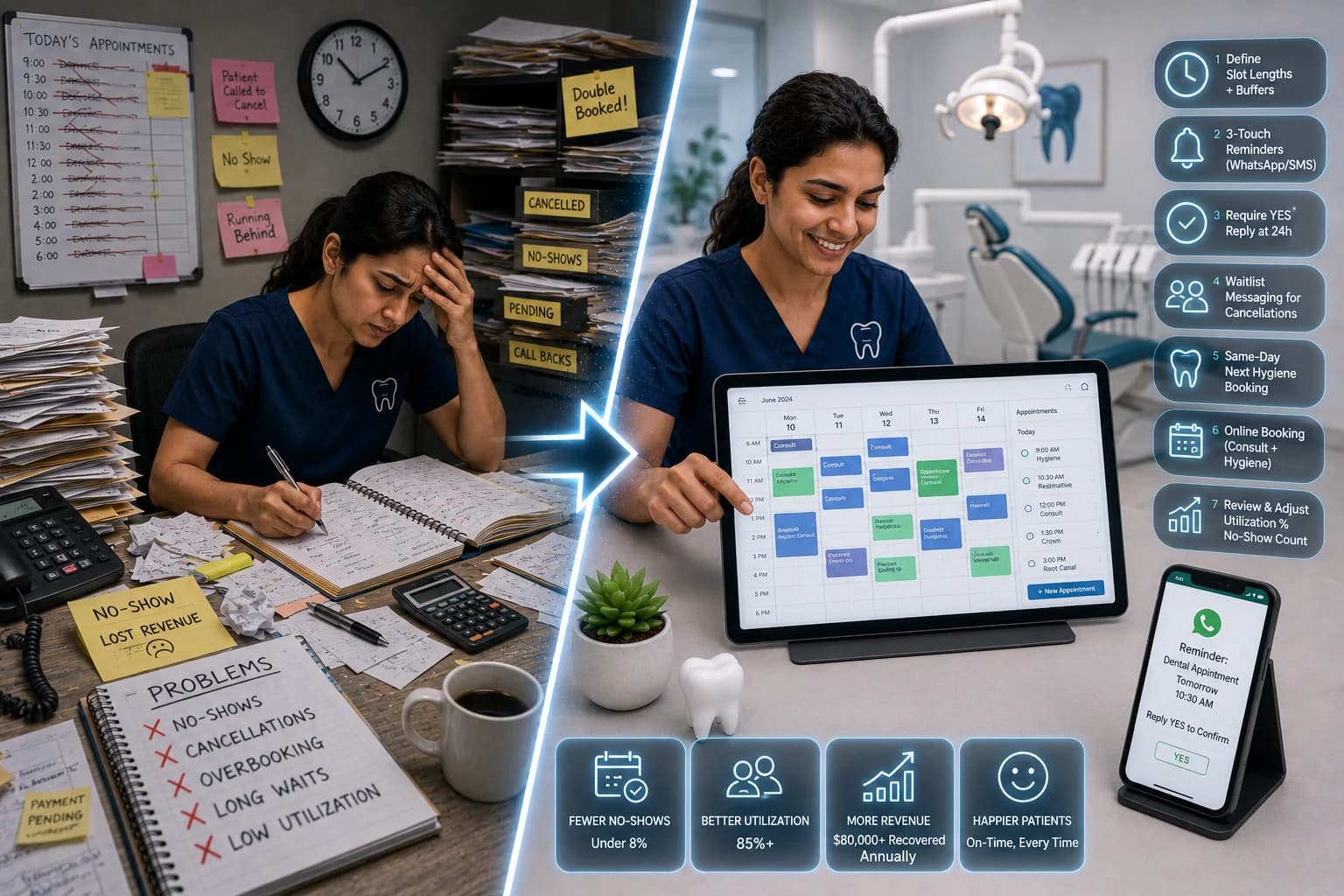
Day 1–2: Define slot lengths per procedure; add buffers in clinic settings.
Day 3: Turn on three-touch WhatsApp/SMS reminders; require YES reply at 24h.
Day 4: Enable waitlist messaging for cancellations.
Day 5: Mandate same-day next hygiene booking.
Day 6: Publish online booking for consult + hygiene only.
Day 7: Review utilization % and no-show count; adjust block template if restorative keeps getting bumped.
The Bottom Line
Small dental clinics do not need enterprise scheduling — they need consistent slots, three-touch confirmations, same-day rebooking, and fast gap recovery. Closing the gap from a 15% no-show rate to under 8% on 25 daily appointments can recover $80,000+ annually without new equipment.
Scheduling is a revenue system, not a receptionist chore. Build the template once, automate confirmations, and measure completed visits — not just filled cells on a calendar.
About Denzif
Denzif is cloud dental practice management for established small-to-mid clinics in Pakistan — patients, appointments, treatments, billing, inventory, WhatsApp reminders, and optional AI on Standard. Get custom PKR pricing or request a private walkthrough.
Frequently Asked Questions
Most small general practices use 30-minute hygiene slots, 60-minute restorative blocks, and 45–90 minutes for crown preps or root canals. Add 5–10 minutes buffer between complex cases. Match slot length to procedure type — not one-size-fits-all 30 minutes.
Ready to put this into practice?
Custom PKR pricing for established clinics. Private walkthrough after we confirm fit. Setup in about 15 minutes.