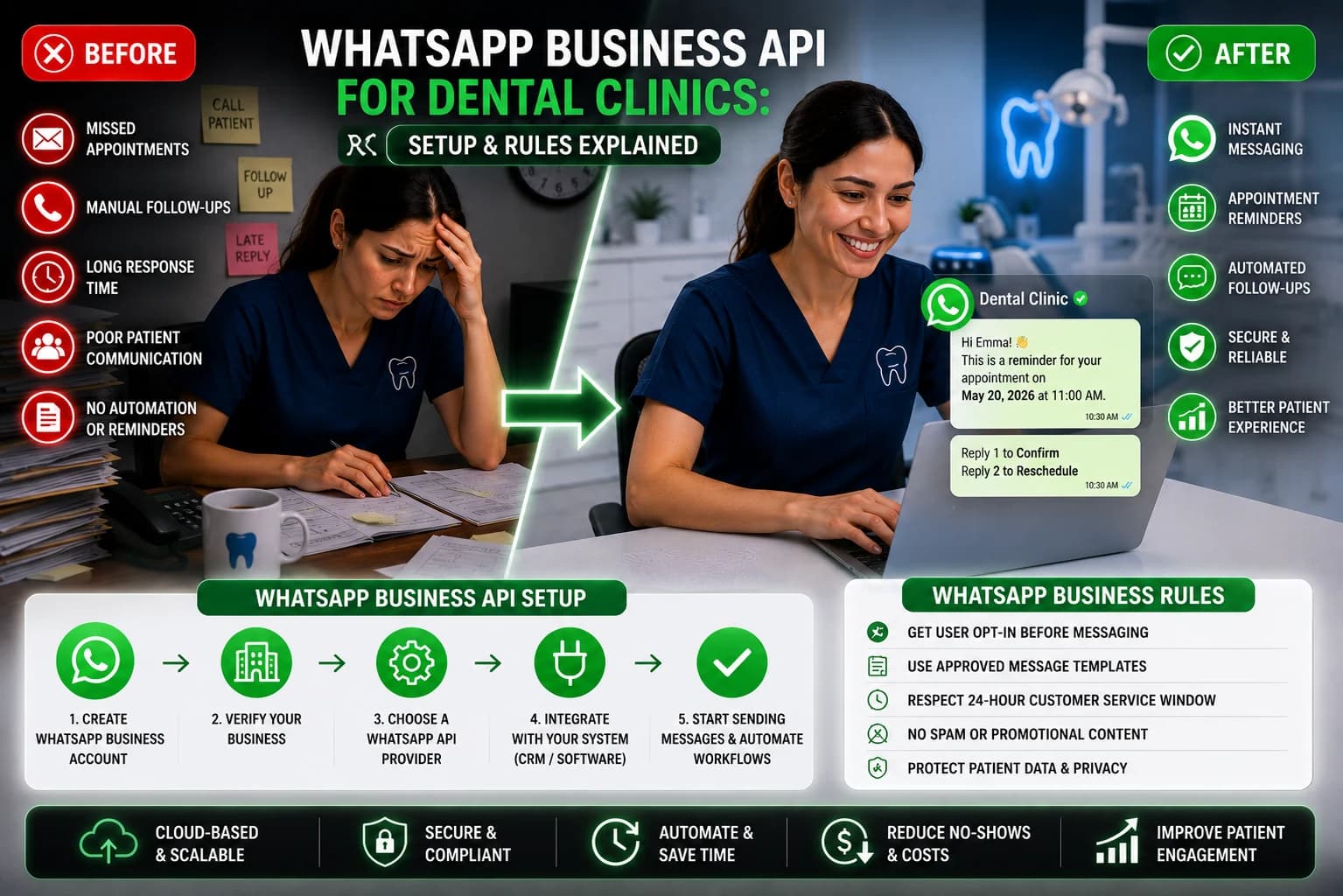
WhatsApp Business API for Dental Clinics: Setup & Rules Explained
Dental clinics outgrow the WhatsApp Business app at ~500+ messages/month. Learn API setup, Meta template rules, opt-in law, and Pakistan-ready integration paths.
Quick answer
The WhatsApp Business API lets dental clinics send approved template reminders at scale — without phone bans from bulk messaging on the consumer app. Setup requires a Meta Business Portfolio, a dedicated number, and a Cloud API or BSP partner; clinics must capture patient opt-in and avoid clinical detail in templates.
Your receptionist still copies appointment times into WhatsApp by hand. It worked at 15 patients a day. At 40+, messages pile up, confirmations get missed, and Meta flags the number for bulk sending — the same channel that should cut no-shows becomes a ban risk.
The fix is not "message harder." It is graduating from the WhatsApp Business app to the WhatsApp Business Platform (API) — Meta's official path for automated, high-volume clinic communication. Clinics that pair API reminders with live scheduling routinely see the 40–60% no-show reductions documented in our WhatsApp automation guide, without fighting platform limits.
This article explains when to switch, how setup works, what Meta allows dental clinics to send, and how Pakistan practices can go live inside integrated dental WhatsApp automation instead of stitching APIs together manually.
Key takeaways
- The WhatsApp Business app suits low volume; the API is required for reliable automated reminders at scale.
- Setup needs a Meta Business Portfolio, dedicated phone number, WABA, and Cloud API or BSP integration.
- Pre-approved templates are mandatory for outbound messages outside the 24-hour reply window.
- Collect explicit opt-in at booking; honor opt-outs immediately to protect quality rating.
- Keep templates to scheduling logistics — not clinical diagnoses or full treatment details.
- Meta does not sign HIPAA BAAs — US practices need separate compliance review; Pakistan clinics follow Meta policies plus local privacy norms.
- Integrated dental software should trigger reminders from appointment records in PKT with credit tracking.
WhatsApp Business App vs API: Which Do Dental Clinics Need?
| Channel | Best for | Limits |
|---|---|---|
| WhatsApp (personal) | Staff DMs only | No automation; ban risk on bulk sends |
| WhatsApp Business app | Solo dentist, under 200 reminders/month | Manual or basic labels; no deep CRM sync |
| WhatsApp Business API | Multi-chair clinics, automated sequences | Templates + opt-in; per-conversation Meta fees |
Rule of thumb: If reminders are still copied from a paper register or spreadsheet, you are losing money on no-shows before API fees even matter — see no-show revenue math. If your team sends 500+ templated messages monthly or needs two-way confirm/cancel tied to the schedule, plan API migration within one quarter.
Karachi and Lahore urban practices often hit the threshold faster because WhatsApp is the default patient channel — our Karachi no-show playbook shows why channel fit beats more phone calls.
What the WhatsApp Business API Actually Is
Meta's WhatsApp Business Platform lets approved businesses send messages through:
1. Cloud API — you or your developer connect directly to Meta's hosted endpoints (Meta Cloud API documentation).
2. Business Solution Provider (BSP) — a Meta partner (e.g., Infobip, Twilio, MessageBird) hosts onboarding, template tooling, and support.
Both paths require a WhatsApp Business Account (WABA) linked to exactly one Meta Business Portfolio. A WABA holds approved templates, phone numbers, and billing for conversation charges.
Dental clinics rarely need custom Cloud API code. Most adopt API access through dental software or a healthcare-focused BSP so reminders fire from appointment rows automatically.
Step-by-Step: WhatsApp Business API Setup for Dental Clinics
1. Prepare Meta Business Portfolio
- Create or access Meta Business Suite with admin rights.
- Legal business name and address must match verification documents.
- A live website matching the clinic entity speeds approval.
2. Choose and verify a phone number
- Must receive SMS or voice OTP.
- Cannot be active on personal WhatsApp or the Business app — delete the old account first or use a new SIM.
- Many Pakistan clinics use a dedicated 03XX clinic line forwarded to reception.
3. Create WABA and connect the number
- In Meta App Dashboard → WhatsApp → API Setup, create or link a WABA (WABA overview).
- Display name should match clinic branding patients recognize.
- Complete business verification when Meta prompts — delays here are the #1 onboarding blocker.
4. Submit message templates
Templates are Meta-reviewed scripts with {{variables}} for patient name, date, time, dentist, and address. Common dental utility templates:
- Booking confirmation — sent immediately after an appointment is created.
- 24–48 hour reminder — includes confirm or reschedule instruction.
- Day-of reminder — sent 2–3 hours before the slot.
- Follow-up / recall — hygiene or check-up due (watch category rules).
Approval often takes minutes to 48 hours. Rejections usually mean promotional language in a utility template or missing opt-out wording.
5. Integrate with scheduling software
Map events: appointment.created, appointment.updated, appointment.cancelled. Pass PKT date/time strings patients expect. Write inbound replies (CONFIRM, CANCEL, button taps) back to appointment status so chairs do not stay blocked for ghost slots.
Denzif first-party note: Paid plans include 50 WhatsApp messages per month with additional WhatsApp billed with your clinic plan, template and session replies tied to appointment records — no separate BSP contract for standard reminder workflows.
6. Test, then scale the sequence
Pilot with 50 patients. Measure confirmation rate, opt-out rate, and no-show delta over 30 days before enabling recall or marketing templates.
Meta Rules Dental Clinics Cannot Ignore
Opt-in and opt-out
Patients must agree to WhatsApp messages when they share a mobile number — checkbox on your online booking form, front-desk script, or paper registration. Log consent in the patient record.
Every marketing template needs clear opt-out language. If a patient says STOP or asks to leave, suppress immediately. High block/report rates lower your quality rating and throttle future sends.
The 24-hour customer service window
After you send a template (or the patient messages you), a 24-hour session opens. Staff or bots may reply freely — useful for "Can I come 30 minutes later?" Once the window closes, only new approved templates can restart contact.
Design confirm/cancel flows to capture replies inside that window.
Template categories (2026 policy basics)
| Category | Dental use | Notes |
|---|---|---|
| Utility | Appointment reminders, reschedule alerts | Lowest friction; no promotional copy |
| Marketing | Whitening promos, implant specials | Requires opt-in; stricter approval |
| Authentication | OTP for portal login | Rare in dental unless custom apps |
Blurring utility with discount language gets templates rejected or recategorized to higher pricing.
Quality rating and limits
Meta tracks blocks, reports, and delivery failures. Clinics that blast cold lists see tier downgrades — from thousands of daily conversations to hundreds. Warm, opted-in appointment traffic from your own patient base rarely triggers issues.
What not to put in WhatsApp messages
- Full radiograph reports or pathology details
- Complete medication lists with dosages
- Unencrypted sensitive IDs beyond what scheduling requires
For clinical content, use in-person discussion or secure channels your compliance advisor approves. This aligns with global guidance that Meta does not offer HIPAA Business Associate Agreements for WhatsApp — US practices must not treat the consumer channel as PHI storage (Meta policy context).
Pakistan clinics are not HIPAA-regulated, but patient trust still demands minimum-necessary messaging — appointment logistics only in templates.
Costs: API Fees vs Empty Chair Loss
Meta bills per 24-hour conversation window by category, not per SMS segment. Utility appointment threads are typically the cheapest. Marketing campaigns cost more.
Illustrative monthly math (mid-size clinic):
- 900 utility reminder conversations × low-tier Meta pricing ≈ $25–70 Meta fees
- BSP or software platform fee (varies; may be bundled)
- One prevented no-show at PKR 55,000–105,000 production value pays for years of messaging
Compare that to the PKR 240,000+ monthly loss busy Karachi schedules report when 15–25% of slots go empty. API fees are rounding error next to chair time.
Pakistan-Specific Setup Notes
- Dominant channel: Patients expect Roman Urdu or English templates with clinic name, doctor, date, time, and map pin — not email.
- Phone format: Store mobiles as 923XXXXXXXXX; display as 03XXXXXXXXX in templates.
- Load-shedding: Cloud API sends do not depend on on-prem servers — reminders fire if your software host is up.
- Cash clinics: WhatsApp handles confirmation; payment discussion stays at front desk unless you use approved utility wording for balance reminders.
- Regulation: Follow Meta commerce policies and sensible local privacy practice — do not claim HIPAA certification for any software vendor.
Pair API reminders with a structured follow-up system so cancelled slots refill from a waitlist instead of leaving gaps.
Build vs Buy: API Integration Paths
| Path | Pros | Cons |
|---|---|---|
| Direct Cloud API | Full control, lowest Meta markup | Needs developer, template UI, hosting |
| BSP (Twilio, Infobip, etc.) | Faster go-live, support | Extra per-message markup, separate contract |
| Dental software with WhatsApp built-in | Appointment-native, one login | Less customization for exotic workflows |
For most Pakistan dental clinics, built-in dental software integration is the fastest ROI — reminders, credits, and appointment status in one place beats exporting CSVs to a generic BSP dashboard.
Common Setup Mistakes (and Fixes)
1. Using a receptionist's personal number — ban affects personal chat history. Fix: dedicated clinic SIM on API.
2. Skipping template approval — sending ad-hoc bulk blasts from the Business app. Fix: migrate templates before volume spikes.
3. No opt-in checkbox on web forms — quality rating crashes. Fix: explicit consent copy on booking step 3.
4. Clinical detail in reminders — "Your biopsy result is positive" in WhatsApp. Fix: logistics only; call patient for results.
5. Ignoring timezone — UTC-stored times confuse patients. Fix: PKT everywhere in templates and software.
The Bottom Line
Dental clinics graduate to the WhatsApp Business API when manual reminders break — usually around 500+ monthly messages or multi-dentist schedules. Setup means Meta Business verification, a clean phone number, approved utility templates, and software-triggered sends with documented opt-in.
Done right, API automation delivers the same 40–60% no-show reductions as manual WhatsApp — without ban risk and with confirm/cancel data flowing back to the chair chart. Meta fees are tiny next to one recovered implant or ortho day.
About Denzif
Denzif is cloud dental practice management for established small-to-mid clinics in Pakistan — patients, appointments, treatments, billing, inventory, WhatsApp reminders, and optional AI on Standard. Get custom PKR pricing or request a private walkthrough.
Frequently Asked Questions
Clinics sending under 200–300 automated reminders monthly can start with the WhatsApp Business app and saved quick replies. Once you need CRM-linked automation, multi-staff inbox routing, or hundreds of timed reminders without manual sends, Meta requires the Business API through Cloud API or a Business Solution Provider.
Ready to put this into practice?
Custom PKR pricing for established clinics. Private walkthrough after we confirm fit. Setup in about 15 minutes.