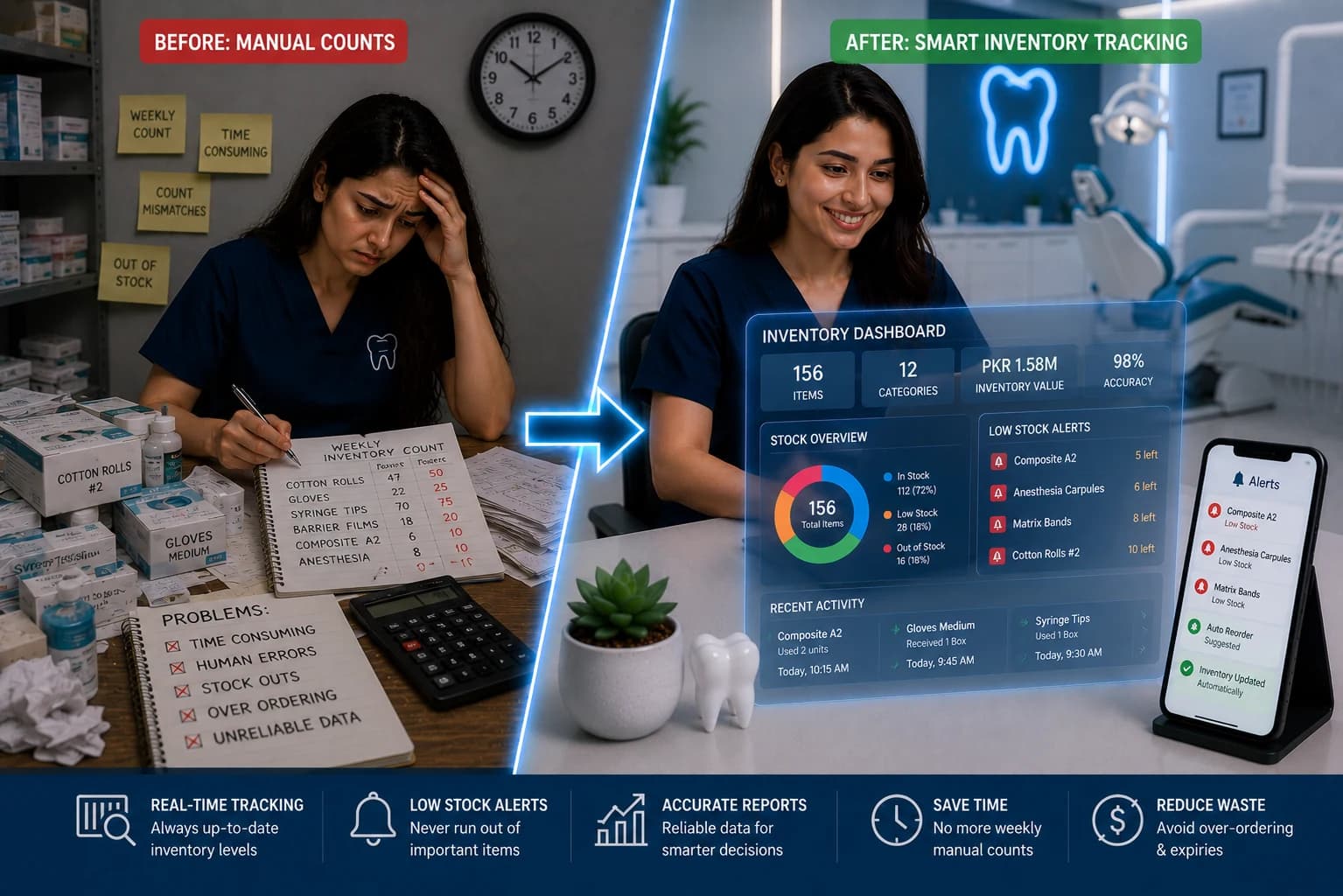
Dental Inventory Tracking Without Weekly Manual Counts (2026 Guide)
Stop counting every glove box on Saturday. Learn cycle counting, usage-based updates, and reorder alerts that cut inventory work from 6+ hours to under 2 per week.
Quick answer
You do not need a full manual count every week to control dental stock. Cycle counting — auditing 20–30 high-turnover SKUs on rotation — plus usage logging and reorder-level alerts typically cut inventory labor from 6–12 hours to 1–3 hours weekly while reducing stockouts roughly 15%.
Saturday inventory marathons are a tradition in dentistry — and a trap. Staff count hundreds of SKUs while patients wait Monday, numbers drift by Wednesday, and someone still runs out of anesthetic before the afternoon block.
You do not need a full manual count every week to run a tight clinic. You need a system that updates stock when items move, checks high-risk SKUs on rotation, and alerts you before zero — not after a procedure stalls.
This guide shows how to track dental inventory without spreadsheet chaos or weekly all-hands counts. If you have not fixed the underlying mistakes yet, start with inventory management mistakes most dentists make — this post is the operational upgrade path.
Key takeaways
- Full weekly counts are overkill — cycle counting 20–30 SKUs per week catches drift faster than one exhausting audit.
- Reorder levels replace guesswork — par alerts trigger orders before stockouts, not after visual panic.
- Log usage at the moment of use — one scan or one tap beats reconstructing the week from memory.
- Software cuts labor 70–80% — disciplined clinics move from 6–12 hours of inventory work to 1–3 hours weekly.
- Critical SKUs first — anesthetic, composite, gloves, and burs drive most production delays; count those on rotation.
- Quarterly true-ups — a full audit four times a year reconciles drift; monthly panic counts are not required.
Why weekly full counts fail
They are accurate for one day
A count on Saturday morning does not know that Monday's implant block used four extra kits, that Tuesday's associate opened two composite syringes, or that someone "borrowed" gauze from the wrong drawer. By mid-week, the spreadsheet is fiction.
NetSuite's dental inventory guidance recommends automated monthly cycle counts to catch problems before they compound — because static snapshots decay the moment staff walk back into ops.
They consume chair-side talent
Industry benchmarks put manual inventory work at 6–12 hours per week for mid-size practices when counting, ordering, and chasing vendors are all ad hoc. That is nearly a part-time role spent on boxes — not patients. Multi-location groups multiply the pain when each branch counts differently.
They teach the wrong habit
When the only fix for uncertainty is "count everything," staff learn to eyeball shelves instead of logging usage. The alternative is event-based tracking: stock changes when something is used or received, and cycle counts verify — not rebuild — the ledger.
The three-layer tracking model
Think of inventory control as three layers. You need all three; none replaces the others.
| Layer | What it does | How often |
|---|---|---|
| Usage logging | Decrements stock when items leave storage | Every use / every procedure block |
| Reorder alerts | Flags SKUs at or below par level | Continuous (software) or daily glance |
| Cycle counting | Physically verifies a subset of SKUs | Weekly rotation + quarterly full audit |
Layer 1: Log usage when it happens
The lowest-tech version: lead assistant marks a tally sheet when a composite syringe opens. Better: dental inventory software where staff adjust quantity on receive and use.
The rule is simple — if it left the shelf for a patient, the count moves. Waiting until Friday guarantees miscounts.
Layer 2: Par levels and reorder triggers
Par level = (average daily use × lead time in days) + safety stock
Example: 2 anesthetic cartridges per day, 5-day supplier lead time, 2-day buffer → par = 14 cartridges.
Set software or spreadsheet conditional formatting to highlight "at par." Order then — not when the drawer looks empty. This alone eliminates most 22–38% rush-order premiums described in supply-chain benchmarks.
Layer 3: Cycle counting (not full counting)
Cycle counting audits a slice of inventory each week:
| Week | Focus area | Typical SKU count |
|---|---|---|
| 1 | Top 20 by annual spend | 20 items |
| 2 | Anesthetic, composite, gloves, burs | 25 items |
| 3 | Impression and lab materials | 20 items |
| 4 | Low-turnover + expiry sweep | 15 items + red-tag review |
Practices using regular cycle counts report ~15% fewer stockouts than visual-guess systems (supply chain industry surveys). You touched every important SKU within a month — without counting 400 line items every Saturday.
Manual-light workflow (no barcode required)
Not every clinic needs RFID tags on day one. This workflow works with a single ordering owner and a cloud dashboard:
1. Master SKU list — 100–150 active items, one row each, with par level and storage location.
2. Receive protocol — delivery logged same day; new stock goes behind older stock (FIFO).
3. Use protocol — assistant decrements count when opening critical items (or end of day batch for low-risk consumables).
4. Monday 15-minute review — dashboard or highlighted spreadsheet: what is at/below par?
5. Wednesday cycle count — 20 SKUs from the rotation table; note variances and fix root cause.
6. Quarterly audit — full count to reconcile; adjust par levels from real usage data.
Staff time target: under 2 hours per week once habits settle — versus 6+ hours of full counts and firefighting.
When software beats spreadsheets
Spreadsheets fail when:
- Two people edit the same file and overwrite counts
- No one gets alerted until a stockout happens mid-procedure
- Expiry dates live only in someone's memory
- Inventory is separate from billing and scheduling — so supply orders do not match case volume
Integrated dental inventory software should provide:
- Item list with quantity and reorder level
- Low-stock visibility on one dashboard
- History of who adjusted counts and when
- Categories for critical vs routine SKUs
The ADA practice management resources emphasize that automation handles expiration alerts, reorder notifications, and usage trends that spreadsheets struggle to maintain — adoption can start with one function (reorder alerts) rather than a big-bang rollout.
Comparison: weekly full count vs cycle count + alerts
| Metric | Weekly full manual count | Cycle count + reorder alerts |
|---|---|---|
| Staff time | 4–8+ hours/week | 1–3 hours/week |
| Stockout frequency | 8–14/month (mid-size) | 0–2/month |
| Data accuracy mid-week | Low (stale after Monday) | Higher (usage logged daily) |
| Expired stock discovery | Often during procedures | Monthly expiry sweep |
| Scales to multi-chair | Poor | Good with one SKU list |
30-day transition plan (ditch the Saturday count)
Week 1: Export invoices; list top 50 SKUs by spend; set par levels for critical 20; assign one ordering owner.
Week 2: Move counts into software or a locked shared sheet; log receives; start FIFO labeling on expiring items.
Week 3: Launch cycle count rotation (20 SKUs); cancel the full weekly count; add Monday par review to the huddle.
Week 4: Measure stockouts and staff hours saved; trim one redundant vendor; document the SOP for new assistants.
Target: 15–20% supply cost reduction in year one — aligned with what disciplined practices report after par levels and cycle counting (inventory ROI analyses).
Pakistan clinic notes
- WhatsApp ordering to three suppliers without a master list creates duplicate deliveries — one weekly order cadence per vendor, triggered by par alerts, not "we might be low."
- Import lead times on implant kits and specialty materials need longer par buffers — treat as critical-tier SKUs in the rotation.
- Cash tied in drawers — carrying 60–90 days of stock is common when counts are guesswork; cycle counting exposes over-ordering faster than annual audits.
- Load-shedding does not excuse lost counts — cloud inventory dashboards stay accessible when local servers do not.
Tie inventory to clinic operations
Inventory is not a back-office hobby. It connects to seven major problems that stall clinics — wasted cash, stressed staff, and schedule chaos when materials run out mid-procedure.
Multi-dentist scheduling assumes supplies exist for every chair. When inventory is invisible, you schedule production you cannot deliver — and pay the rush-order tax to recover.
The Bottom Line
Weekly full manual counts feel responsible but often waste 6+ staff hours while stockouts still happen mid-week. Cycle counting, usage logging, and reorder-level alerts give you tighter control with 1–3 hours of weekly attention — and roughly 15% fewer stockouts when the rotation stays consistent.
Start with your critical 20 SKUs, set par levels from real lead times, and let software flag exceptions so humans count only what drifts.
About Denzif
Denzif is cloud dental practice management for established small-to-mid clinics in Pakistan — patients, appointments, treatments, billing, inventory, WhatsApp reminders, and optional AI on Standard. Get custom PKR pricing or request a private walkthrough.
Frequently Asked Questions
Replace full weekly counts with cycle counting: audit a rotating slice of SKUs (top 20 by spend one week, anesthetic and composites the next). Log usage when items leave storage, set reorder-level alerts, and run a quarterly full audit. Software dashboards flag low stock so you only count exceptions.
Ready to put this into practice?
Custom PKR pricing for established clinics. Private walkthrough after we confirm fit. Setup in about 15 minutes.