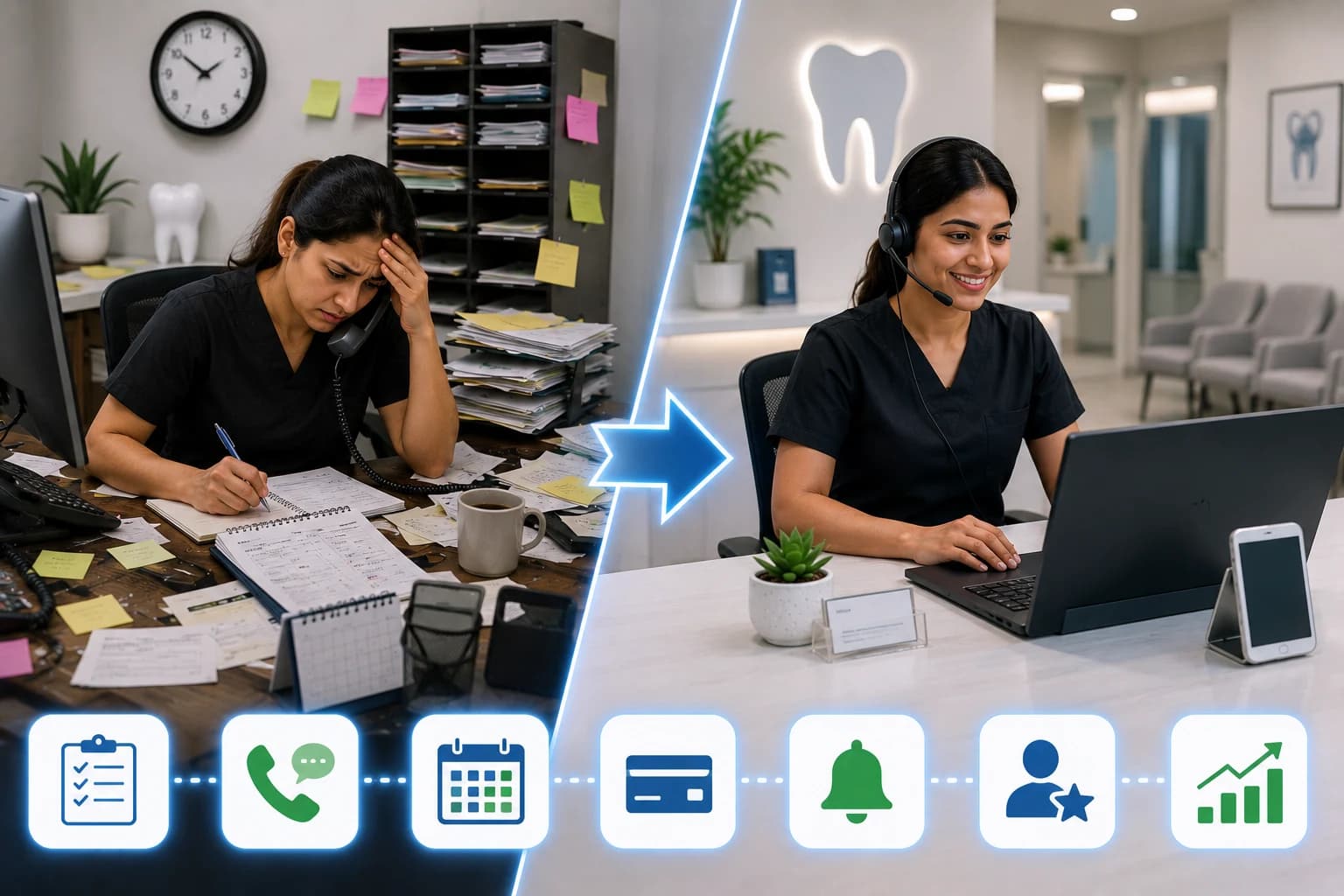
Scheduling Frustrations Are Driving Dentist Burnout — How Technology Fixes It
58% of dentists report weekly burnout. Open hygiene slots cost $200–$400 each. See how smart scheduling, automation, and AI cut admin overload in 2026.
Quick answer
Dentist burnout often traces to scheduling chaos and admin overload. Automated WhatsApp reminders and cloud scheduling cut front-desk calls; Denzif AI agents on the AI plan handle recall and follow-up.
58% of dentists report work-related burnout every week. Not once a quarter — weekly (CareQuest Institute oral health workforce data). Meanwhile each empty hygiene slot bleeds $200–$400 in production, your front desk juggles 60–70% of bookings still arriving by phone, and you finish charts after dinner because the day was spent on scheduling disruptions — not dentistry.
Search trends mirror the pain: queries like "scheduling software frustrations dental offices 2026" and "dental scheduling disruptions" are rising because legacy tools digitized the calendar but not the chaos.
This article connects scheduling frustration → burnout → technology that actually removes load — with numbers, comparison tables, and a 21-day fix path for owners who are tired of being part-time schedulers.
The Real Cost of Scheduling Chaos
What owners feel vs. what metrics show
| Symptom | Likely metric | Annual impact (mid-size GP) |
|---|---|---|
| "Why is Tuesday always a disaster?" | Template mismatch to procedure length | $20,000–$40,000 lost production |
| Constant phone interruptions | 15–25 admin pings/day to doctor | 1–2 hrs daily × 250 days |
| Hygiene holes | 3–8 open slots/week | $31,000–$166,000 |
| No-shows without backfill | Broken rate above 8–10% | Tied to no-show revenue loss |
| Staff quitting front desk | 30–40% turnover | $14,000–$26,000 per exit |
| Evening charting | 5–10 hrs/week unpaid admin | Burnout + error risk |
84% of dentists report moderate to high stress in ADA-aligned surveys; more than one in four have considered leaving the profession (Ripe Global burnout analysis). Scheduling is rarely the only cause — but it is the daily friction that prevents recovery.
Why "We Already Have Software" Still Hurts
Common scheduling software frustrations (2026)
1. Double entry: Book in PMS, then WhatsApp patient manually, then write on whiteboard
2. Dumb reminders: Text blasts with no confirm/cancel loop — automation done wrong
3. No provider rules: System allows bookings that violate doctor/chair logic — fixed by humans arguing
4. Siloed modules: Schedule does not see billing hold or incomplete forms — surprises at check-in
5. Reporting after the fact: You learn no-show rate monthly, not daily
6. Phone-first world ignored: Online portal exists; 60–70% still call (dental scheduling automation benchmarks)
If your team still maintains a parallel paper schedule, see how that compounds stress in pen-and-paper operations.
Technology That Reduces Stress (Not Adds Login Fatigue)
Layer 1 — Scheduling discipline (no new vendor)
| Fix | Effort | Stress removed |
|---|---|---|
| Standardized appointment templates | 1 ops meeting | Fewer overruns |
| Provider-specific bookable types | 2 hours setup | Stops illegal bookings |
| Same-day block for emergencies only | Policy + template | Protects production |
| Daily 4 p.m. tomorrow review | 15 min ritual | Surprises drop 30%+ |
Start with small clinic scheduling best practices before buying more tools.
Layer 2 — Automated patient communication
| Capability | Benchmark impact |
|---|---|
| 48h + 24h WhatsApp/SMS reminders | 25–40% no-show reduction |
| Confirm / cancel keywords | Real-time gap visibility |
| Waitlist backfill texts | 15–20% better utilization |
| Online booking for hygiene | Fills evenings/weekends without calls |
Practices report 40–60% less front desk phone time when reminders and self-service actually sync to the live schedule (automated scheduling ROI data).
Layer 3 — Integrated clinic platform
One login for:
- Schedule + chair/dentist rules
- Patient record + odontogram
- Billing status at booking ("balance due" flag)
- Inventory alerts (procedure needs material in stock)
- AI-assisted notes after procedures
Context switching — jumping between four apps — is a hidden burnout driver. Integration removes "let me check the other system."
Layer 4 — AI where it saves evenings, not replaces judgment
High-ROI AI in 2026:
- Draft post-op and SOAP notes for dentist review
- Summarize day schedule gaps and suggest waitlist pulls
- Answer routine patient FAQs via chat when staff is with patients
- Flag high no-show-risk appointments for extra confirmation
Low-ROI AI (skip for now):
- Fully autonomous clinical diagnosis without oversight
- Generic chatbots not connected to your appointment data
Manual vs. Integrated Scheduling: Stress Comparison
| Factor | Manual / fragmented software | Integrated + automation |
|---|---|---|
| Daily schedule changes after hours | 8–15 | 2–5 |
| Front desk phone hours/week | 25–35 | 10–18 |
| No-show rate | 10–18% | 5–9% |
| Doctor interruptions for scheduling | 10–20/day | 3–8/day |
| Evening admin (charts + schedule) | 5–10 hrs/week | 2–4 hrs/week |
| Owner confidence in tomorrow's board | Low | High |
21-Day "Less Firefighting" Implementation Plan
Week 1 — Visibility
- Track no-shows, same-day cancels, and open slots daily (one spreadsheet)
- List top 5 scheduling disruptions from team standup
- Fix template errors for highest-volume procedure types
Week 2 — Automation
- Turn on two-touch reminders (48h + 24h) with confirm prompt
- Enable waitlist for hygiene
- Train front desk on 7-day receptionist SOP for gaps only — not ad hoc yelling into ops
Week 3 — Integration & boundaries
- Eliminate duplicate paper schedule if digital is source of truth
- Set "doctor not disturbed" blocks during clinical hours except true emergency
- Review metrics: target broken appointment rate trending toward ≤5–8%
Pakistan Clinic Context
- WhatsApp is the schedule for many patients — if it is not tied to clinic software, you have two schedules and guaranteed conflict
- Multi-dentist family practices need chair-level rules more than U.S. solo templates — multi-chair guide applies directly
- Load-shedding: cloud-based systems with mobile access beat on-prem servers that die mid-afternoon
- Cash flow stress: empty slots hurt more when fixed costs are in rupees and supplies are imported — utilization is a mental health issue, not only finance
- Owner-as-dentist: you will not meditate your way out of a 14% no-show rate — systems first, wellness second
Signs Technology Is Failing You (Upgrade Triggers)
- More time fighting software than seeing patients
- Reminders sent but schedule still wrong
- Cannot answer "how many open hygiene hours this week?" in 30 seconds
- Every new hire takes 90 days because workflows live in people's heads
- Daily backups and security are afterthoughts while scheduling burns the team daily
If three or more match, the problem is not your team — it is the operating system of the clinic.
The Bottom Line
Scheduling frustrations are not a personality flaw — they are a systems design problem. With 58% weekly burnout, $200–$400 per open slot, and practices cutting front desk phone load 40–60% through integrated automation, the ROI of fixing scheduling is measured in years of career, not only rupees.
Stop patching with whiteboards. Automate confirmations. One platform. Protect clinical focus.
About Denzif
Denzif is cloud dental practice management for established small-to-mid clinics in Pakistan — patients, appointments, treatments, billing, inventory, WhatsApp reminders, and optional AI on Standard. Get custom PKR pricing or request a private walkthrough.
Frequently Asked Questions
Daily firefighting: double-bookings, last-minute gaps, no-shows without backfill, phone tag for confirmations, and front desk asking clinical questions mid-procedure. Each interruption breaks focus and extends hours — a top driver of the 58% of dentists reporting weekly burnout.
Ready to put this into practice?
Custom PKR pricing for established clinics. Private walkthrough after we confirm fit. Setup in about 15 minutes.